

 Posted by
The purpose of this segment is to provide information, entertain, and share experiences into the world of the writer. Whether you are more of a hobbyist or write professionally, hopefully you will find the information presented here to be useful, humorous, or stand as a cautionary tale.
Any author may participate (email me if you are interested in contributing at srovens@yahoo.com). If you have an idea for a topic or wish to see something specific presented, please let me know.
Topics Covered (newest to oldest):
In Need of Inexpensive Swag?
Starting a New Novel: Rules?
Writing & Music: Do They Belong Together?
ISBNs: What are they and do I really need them?
Websites, Platforms, and Blogs, oh my.
Are Other Authors Your Competition?
“I don’t read. Can I still be a writer?”
Audiobooks Revisited: A Pre-Cautionary Tale
Writing What You Know: Limiting or Freeing?
Location, Location, Location!
Three Year Anniversary!
Outdoor Events: Stay Strong!
Audiobooks: Are They Cost Effective?
Scams!
Take a Breath: National Mental Health Awareness Month
When Life Gets In The Way
Chapter Naming: Is It Necessary?
Blurbs!
When Motivation and Drive Disappear
Being Punctual
NaNoWriMo and the A.I. Debacle
Two Year Anniversary!
Social Networks/Platforms/Apps: Overwhelming or Necessary?
Beta Readers
Checklist for Vendors/Events
2nd Drafts
Inspiration: Where to Find It
Genres: A Brief Overview
Linktree
How NOT to Host an Event
Book Racks for Tables/Events
Writing Dialogue: Part One
Responding to Reviews
One Year Anniversary!
Novels VS. Short Stories – Word Count
Payments & Money
Plansters/Pansters/Plotters
Business Cards: Do They Matter Anymore?
Choosing a Title for Your Book
Changes…
Choosing Events as a Vendor
First Drafts
Trigger Warnings
Book Covers – Some Tips
Editing – Just the Basics
Swag
July 2026
In Need of Inexpensive Swag?
By Sue Rovens
Everything in the world is expensive these days – food, gas, clothing, toiletries, bills. If you are an author/vendor who is still involved in events/fairs, you might consider an inexpensive way to provide something to potential readers (aside from your books) that may offer a momentary yet lingering connection. Handing out a trinket that has your name or author info is a nice reminder, not only of the event, but of you and your work.
I’ve found Oriental Trading (https://www.orientaltrading.com/) to be a good place to start. The products, while not exactly posh or top grade, DO provide an avenue for vendors looking to save money while providing a little ‘something’ for people who stop by their booth.
Over the years, I’ve purchased pencils and had my blog address printed on them. It’s a simple piece of swag that’s child friendly (they come NON sharpened), allows me to hand something out to people who might be on the fence about purchasing my work, and is non-genre specific (everyone needs/uses a pencil at some point, right?)
The company has many options (including religious products, if that’s your bag) to consider – from small to large and everything in between. Again, these products are not of the highest quality but are decent enough for those who are watching their pennies. While I have no personal (or monetary) connection to Oriental Trading, they’ve been around since 1932, and I have come to trust them and their products.
From their website: Oriental Trading Company has one simple mission: to make life more fun. For individuals, nonprofits, churches and schools, our budget-friendly buys provide countless reasons to share smiles while making all of life’s moments more special.
With more than 60,000 unique products, we’re the nation’s largest direct retailer of value-priced party supplies, toys and crafts as well as a leading provider of fundraising products. Whether you’re a mom hosting a birthday bash that’s a smash, a Sunday School teacher shopping for cool crafts or a business owner looking for unique rewards to recognize your team, we’ve got thousands upon thousands of ways to create good times galore.
Check out their website. Get a catalogue and thumb through it. Order a few items and see if they work for you and your needs. With almost everyone having to watch their money these days, finding a company which provides cost effective swag might be the answer you’re looking for.
June 2026
Starting a New Novel: Rules?
By Sue Rovens
I took the month of April to begin novel #6 (no title yet). Since NaNoWriMo doesn’t officially exist anymore, I thought I would ‘steal’ the concept of writing 50,000 words in 30/31 days and do it on my own. The plan was to write 1,667 words a day to achieve the 50,000 word goal. I made it! And yes, you can too. Just pick a month and go for it.
When it comes to starting a new novel, almost everyone has their own ‘rules’ on how to navigate this undertaking. While there are general standards for writing dialogue and prose, trying to stick to a host of arbitrary guidelines is a recipe for disaster. Perhaps not a REAL disaster but attempting to adhere to a long list of ‘rules’ can feel restrictive and may curb any feelings of creativity and enthusiasm which once existed.
Some writers will advocate for making an outline. Others might suggest writing by the seat of your pants (pantsters, which I am one). Still others may advise you to write up an entire analysis and backstory of each main character. I even heard of writers starting at the end and writing chapters in reverse order!
The real point is, if you find ANY of these helpful, try them. If not, come up with your own way. If you want to write a book (or a second, third, fourth, etc.), you need to discover what works best for you and your style.
When people ask, ‘how does one start writing a book’, it IS a good idea to have a concept or a main character as a jumping off point. For example, when I wrote Buried, the only thing I knew was that I wanted to write about a hoarder. I had nothing more…until I decided to place her next to a funeral home. Then I added a dog (Weenie, the dachshund) to dig up something from the cemetery which ultimately led her toward a ‘new hoarding trajectory’. After reading about REAL funeral home directors breaking the law, I decided to add that as a sub-plot. And it continued to build from there…
Starting a new novel is a great opportunity to throw everything at the wall and see what sticks. When I wrote the first draft of Track 9, I was really sick and on medication. Most of that NaNoWriMo draft was scrapped during Draft #2. Literally. I must have deleted at least 90% of that first run through – but that’s okay, because it gave me a base from which to work. I find it’s easier to have SOMETHING on the page and go from there.
When writers tell me that they edit WHILE they are in their first draft, I will suggest that they save editing and re-writes for later drafts. It’s difficult to come up with the perfect dialogue and prose while ideas and concepts are still in the beginning stages. In my current first draft (which should never see the light of day!), I have characters that never made it past the first two chapters. I’ve forgotten full names and just put XXXX in the draft as a place holder. I don’t remember where everyone works or what their spouses’ names were. Since the timeframe is set in 1960, I may have included things, places, phrases, and historical events that either didn’t exist yet or don’t apply. But those things will be caught and corrected in subsequent drafts. The main point is, I’ll have something to work with and will take my time going forward.
Whether you want to write a new novel, play, poem, short story, or anything else, don’t worry and bog yourself down with ‘rules’. Get your ideas down first. Then, whenever you are ready, you can edit, correct, change, follow rules, and/or do whatever you need to do in order to make it better.
May 2026
Writing & Music: Do They Belong Together?
By Sue Rovens
It’s a question that’s asked of many writer – do you listen to music when you write? Spoiler: There is no correct answer. Whether you listen or not while you create is completely up to you. There are, however, some pros, cons, and general thoughts on the matter as this is a very personal choice. Where do YOU fall on the Music vs. Writing spectrum? (Personally, I write best in complete silence – no television, no music, no humans. I can write if there is music being played elsewhere in the house, but not during every draft. Some edits take complete silence to work through, but again, this is my preference)
Pros:
*Listening to music can help spur creative thoughts and ideas. Certain genres of music can inspire specific moods, feelings, and a sense of world building.
*Music, played at a low volume, can help establish a ‘white noise’/ background noise that helps block out other mundane sounds.
*Songs/albums may inspire creation of ideas, plots, characters, or even entire scenarios.
*For some, music helps calm the brain and allows for creativity elsewhere (writing, art, etc).
*Simply enjoying music while taking part in other activities (such as writing) is pleasant for some.
*Music can inspire individuals who feel like they have ‘writer’s block’.
Cons:
*Music (or any background noise) may be distracting to writers. Silence works best for these people.
*Songs with lyrics can distract and complicate the act of writing itself, especially when formulating dialogue or difficult/serious scenarios.
*Music (or television) can pull a writer ‘out of the scene’ they are crafting. Sudden sounds or a change in volume (either direction) can jar someone out of their thought process.
*Even if music itself isn’t distracting, having to change a CD, record, or scroll to another song/playlist may be too invasive if someone is focused on the page in front of them.
If you are new to writing or haven’t tried “the other side of things”, give it a go. If you normally write in silence, try some music. Start with instrumental only, then see where things go. On the other hand, if you normally write with music blaring, give silence a try. See if it helps or hinders your process. You might open up a whole new world…or decide that your original preferences are perfect just the way they are.
April 2026
ISBNs – What are they and do I really need them?
By Sue Rovens
ISBNs (meaning International Standard Book Number) appear on most books (usually with or near a barcode). They are an important part of your book regardless of genre, length, or subject matter. Because of the technical aspect of this topic, I have directly pulled information from Bowker, the official U.S. agency which oversees all things relating to ISBNs.
Normally, I purchase 10 barcodes at a time with one being used for the paperback version and another being used for the Kindle version. Because it takes me two years (or more!) to complete a book, 10 barcodes last quite a while. (they never expire). So, while the initial cost might produce ‘sticker shock’, think pragmatically about how and when you will use them.
***
(The following is taken directly from the Bowker Website – found at the bottom of the article)
The ISBN is a unique identifier for a book or other book-like product (such as an audiobook) that specifies its format, edition, and publisher.
Why should I buy an ISBN?
There are many reasons to purchase an ISBN for your title, including:
- An ISBN improves the likelihood your book will be found and purchased
- An ISBN links to essential information about your book
- An ISBN enables more efficient marketing and distribution of your title
- Most retailers require ISBNs
- Correct use of the ISBN allows different product forms and editions of a book, printed or digital, to be differentiated clearly, ensuring that customers receive the version they require
- An ISBN helps you collect and analyze book sales data
- An ISBN ensures your book’s information will be stored in the Books In Print database
- Books In Print is consulted by publishers, retailers and libraries around world when searching for title information
- The ISBN conveys no legal or copyright protection, however, the use of ISBNs for publications is prescribed by law in some countries
- In some countries a book will be charged higher tax if it does not have an ISBN
- ISBNs are the global standard for book identification
How many ISBNs do I need?
You will need one ISBN for each edition and format of your book. The ISBN identifies the publisher as well as the specific book title, edition and format (hardback, paperback, ePub, PDF, Mobi, Audio…). Any variation of a book would require the use of a unique ISBN to identify it properly. This allows retailers to help the customer understand exactly which version of a title they are purchasing. So, you should consider:
- How many book titles you are planning to publish
- How many formats will each title be created in
- Do you plan to publish future revised editions of these titles
And remember:
- You can purchase ISBNs in advance and register your titles any time after they are obtained.
- ISBNs never expire.
Why should I buy my ISBNs from Bowker?
Bowker is the official ISBN Agency for publishers physically located in the United States and its territories (Puerto Rico, Guam, US Virgin Islands, Northern Mariana Islands, American Samoa, as well as military bases and embassies. If an ISBN is obtained from a source other than the official ISBN Agency, it might not identify the publisher of the title accurately. This can have implications for doing business in the publishing industry supply chain.
Once you set up your account with us, your ISBNs will be added to your account immediately at purchase (Title Assignment Instructions). You will be recognized as the publisher of all book titles associated with those ISBNs. For more information about the ISBN standard, or if you are looking for the official ISBN Agency in your jurisdiction, visit the International ISBN Agency.
March 2026
Websites, Platforms, and Blogs, oh my.
By Sue Rovens
WordPress. Squarespace. Wix. Substack. Ghost. Framer. Blogger. Gumroad.
Multitudes of platform choices currently exist for a writer/author/blogger. Some are free, some have moderate fees, and still others are very costly. It’s a personal choice as to what you prefer (and can afford), so if you are waiting for a definitive answer as to which is the BEST, you won’t find it here.
However, I can share my experiences regarding what I picked, why I chose that particular platform, and why, after many years, I am changing to Squarespace.
When I first started blogging, I chose Blogger. It was free, fairly easy to work with, and for the most part, I understood how to do the things I wanted and needed to do. I was in the early stages of writing, having only put out one or two books at the time. I didn’t know what I didn’t know, so, for me, it was all I needed.
A few years later, I decided to ‘upgrade’. I had written more books and had started attending author fairs and other events. I wanted a more ‘professional online presence’, so I chose WordPress because of its solid reputation. It was a platform that promised 24/7 assistance (for a yearly fee which included my own domain name). I engaged the “help chat” periodically over the past years and always found the people to be great, fast, attentive, and knowledgeable. That was important to me because I’m not tech savvy.
I understood the processes enough to be able to add interviews, post new articles, and set up a few other sections. While there had always been glitches and behind-the-scenes issues, I was content with what the blog was accomplishing for me as an indie author.
Lately, however, I’ve been running into problem after problem when I try to manage the blog (new posts, interviews, updates). I contacted the WordPress staff (as I had done in the past) but was told that the wait was long (every time – different days, various hours, etc). The ‘AI chat’ was no help (when is it ever???) and no matter what I did, I couldn’t get beyond that. Finally, when I was able to reach an actual human being, the only thing they did was send me links to various pages from the WordPress site.
Maybe I’m technologically challenged, but no matter what I tried (after looking through a number of instructions), I still couldn’t get things to work. What the heck was I paying for?
After much deliberation, I decided to make the jump. I hired a professional blog designer and am currently in the process of moving to Squarespace. Why Squarespace? Excellent reputation, relatively long history (started in 2003) for a website service, manageable cost per year, and a ‘guaranteed promise’ of website assistance.
Is this my last move? I sure hope so. Most everything I’ve read about Squarespace appeals to me. Hiring a professional designer is costly, but at this juncture, I know that I need help with my blog, so I’m putting it into someone else’s hands. I can write a book and create a heck of a story, but as far as technology design goes, I now know what I don’t know.
If you find one platform isn’t working for you, try another. If you have been hesitant because of the cost, I understand. (Not everyone can afford to hire someone – I certainly acknowledge that I am fortunate in that regard.) Perhaps, if you are able, try a lower cost option if you’ve been at the free level for some time. If you’re struggling, ask someone for help, to advise, or try another avenue. Just don’t give up. Technology, especially for some of us, is complicated and difficult. While we don’t have to be experts in that field, we do have to contend with it as authors and artists.
What platform do YOU use? Have you switched? Which one do you find works best for you?
February 2026
Are Other Authors Your Competition?
By Sue Rovens
Since 2009, the year I began writing seriously, I consider myself fortunate to have made author acquaintances and friends through events, author fairs, libraries, and even random encounters. Many, though not all, write in the same or similar genre(s) as I do – suspense, thriller, and horror. While some are fairly new to the game, others have been at it for years. Most of the time, meeting these writers has truly been a pleasure. However, there have been a few ‘not so great’ experiences – those who enjoyed more ‘fame’ than the average indie – and were quick to demonstrate their arrogance by either ignoring or condescending to those of us who don’t necessarily make a living as an author.
I’ve entertained the following question in my own head for the past fifteen years – are these other writers my competition? Regardless of where they land on the friend/acquaintance/snobby side, are these people actual rivals and adversaries? Should I be going out of my way to ‘be nice’, share information, or divulge knowledge such as information about other events, cover design, or merch?
Hopefully, after all this time, my answer should be clear. It’s one of the main reasons I’ve been interviewing authors since the blog’s inception.
Other writers, famous or otherwise, are NOT my competition. On the contrary. As hard as I work on my books, I can only put one out every two years, and that’s at best. My books run around 220 pages, so a fast reader is going to get through one in a matter of a day or two. As much as I would love someone to read all eight books, it wouldn’t take that much time. A reader is going to seek out the NEXT thing (as well they should!)
And that’s where other authors come in. As a crucial part of the writing community, ALL authors help to boost sales of ALL books. They are collaborators, friends, fellow commiserators, and most importantly, supporters, both personally and professionally.
We shouldn’t view other authors as rivals or saboteurs. Instead, as a collective, we should be boosting the signal of one another’s work. If we aim to help, share, and promote one another, then everyone benefits. For example, while my books may not be someone’s cup o’ tea, my friend’s horror novel might fit what a reader is searching for perfectly. What is the harm in sharing that information? Hopefully, that author will return the favor if the opportunity arises. In doing this, not only are we helping a ‘customer’ find what they are looking for, but we are concurrently boosting the signal for another writer. It’s a win-win, hands down.
So, the next time you’re eyeballing that author sitting next to you at a book fair, instead of looking at them as competition, consider this: ‘The rising tide lifts all the boats’.
January 2026
“I don’t read. Can I still be a writer?”
By Sue Rovens
As writers (of any genre), it’s quite likely that we are also readers. It’s rather important to be a reader, especially if you are qualifying yourself as an author. Still, admitting that you don’t like to read (or in some cases, hate the activity) might come across as blasphemy. How can a person who doesn’t enjoy the product want to take part in the creation of said thing? How does that work?
Think about that concept for a moment. In some ways, it makes sense. For example, a person might not know how to drive a motorcycle (or enjoy the experience of riding one), but they can work in a factory that makes them. Another person might really hate licorice yet find working in a candy shop to be rather fun. Does liking (or not liking) one thing automatically cancel out the other? Does this work for writing and reading?
I’m going to take a stand: If a person wants to be a good writer, that same person will need to crack open a book (or two or three or more). While there probably exists a few authors who simply have a gift for the written word without having to do much in the way of building up a knowledge base or garnering experience through reading others’ works, those cases are few and far between. ANY person can write, but what does it take to write well enough for people to seek out your work? What drives the reader to come back time after time, waiting with bated breath for your next novel/story?
Reading a good book not only provides but illustrates how to construct and shape a compelling story. To create a main plot, sub-plots, intriguing characters with viable arcs, realistic dialogue that doesn’t sound the same for each person, and issues/problems/hardships/etc. is a difficult and complex thing. Reading other people’s work will not only help a writer see how others handle these concepts but will also show what does and doesn’t work.
If a person does NOT choose to read, yet wants to write for an audience, I fear they are putting themselves at a great disadvantage. Regardless of the genre or style, books generally follow an elementary pattern – a beginning, a middle, and an end. Still, how many books have you read that fall apart in the middle or didn’t quite nail the ending? A good writer understands that when the middle sags, something must be added or adjusted – a plot arc, a character flaw, a new villain, etc. A good writer realizes what it takes to hold the reader’s attention, and much of that is based on experience, trial and error, a bit of luck, and a lot of creativity – much of which comes from reading others’ works.
Would the non-reader know that it’s not a good idea to divulge every character’s entire story arc in the first few pages? Would they realize that regurgitating every plot point in each chapter will come across as redundant and boring? How real will their characters’ dialogue be? Can they introduce new characters without coming across as awkward or ill-timed? Fleshing out an ending where all the plot points connect in the final chapters might not even be on their radar. Is any of this possible if you don’t read? Perhaps, but I’m willing to bet that it’s unlikely.
What say you, good people? Is reading the foundation of being a good writer?
December 2025
Audiobooks Revisited: A Pre-Cautionary Tale
By Sue Rovens
I recently received what appeared to be a miracle in my inbox the other day. It was a FREE opportunity to create audiobooks through KDP/Amazon, and as far as I could tell, there really wasn’t much of a catch. I had been hoping to offer my books in audiobook form at SOME point, but the high cost of production had always been an obstacle.
As indie authors, being able to provide our work in a variety of formats is a no-brainer. People have their preferences when it comes to reading – paperback, Kindle, audiobooks, etc. My eight books come in paperback AND Kindle formats, but creating audiobooks has always been financially (and technically) out of my reach. On average, a high-quality audiobook can cost upwards of $1,500 (and beyond) to produce. If you personally have the know-how and equipment, the cost would be lower, however, if you are anything like me, a DIY audiobook is simply not in the cards.
Enter KDP/Amazon. Not only are they willing to produce your audiobooks (for FREE), but you can also select the type of voice (male or female), general age, and, in some cases, specific accents. The process itself is fairly easy and quick. After deciding who you’d like as the voiceover, you choose a price for your book, and the distribution channel(s). They claim that the finished product will go LIVE in a matter of days (or sooner).
I was so excited by this prospect that I was ready to jump in and make it happen. I was beyond ready to share my soon-to-exist audiobooks with future consumers who prefer this particular format. It was sure to be a win-win, right?
Not so fast.
After doing a bit of online research, I discovered that although the process may be free and easy, the quality of this opportunity is NOT something that consumers have been eagerly seeking out. First and foremost, the voiceovers are A.I. generated. While I am not a fan of A.I. in creative endeavors, I didn’t realize how it would affect the sound/reading experience. From what I could tell, the ‘voiceover’ reads EVERY WORD. That means everything on the copyright page through to the biography or whatever you might have in the back of the book. There is also little to no inflection, making dialogue and intent almost impossible to distinguish. It reads it straight through, without being able to take the context into consideration. For example:
“They read the red book” could sound like “They REED the red book”.
Apparently, there is a way to ‘tweak’ some of the phrasing and words. However, other authors who have utilized this program stated that it’s not very easy and can take hours to get a word/phrase/enunciation just right.
The biggest issue consumers have is that they simply don’t/didn’t like listening to an A.I. voice read a novel. Audiobooks, at least for the time being, are better received when a human voice is at the helm and not a computer-generated counterpart. That was enough for me to take a pass regardless of the FREE price tag.
Here is the email I received from KDP/Amazon. Have YOU received one, and if so, did you venture into the world of A.I. voiceovers or are you waiting for something better to come along?
Expand your reach with a digital audiobook! Audiobook Creation Exchange (ACX) makes it easy to produce and distribute your digital audiobook. You’ll also be able to take advantage of the exciting new Kindle features Whispersync for Voice and Immersion Reading to reach more readers in more ways.
Use ACX to produce a digital audiobook edition of your book using our marketplace of professional audiobook producers and earn royalties of up to 40%. ACX provides access to thousands of talented audiobook producers, and both actors and studios, available for hire for a fee or for a no-cost, royalty-sharing partnership. ACX also provides distribution options to the leading retailers of audiobooks: Audible.com, Amazon.com, and iTunes, as well as their global partners. It’s free to try ACX.
Authors can learn more about ACX at www.acx.com.
November 2025
Writing What You Know: Limiting or Freeing?
By Sue Rovens
The old adage of ‘write what you know’ can only get you so far.
Has Stephen King personally known vampires? Did J.K. Rowling ever attend a school for wizards? What about Agatha Christie? Am I right to assume that she never actually murdered any of her dinner party guests? 😉
When someone tells you to only write what you know, take that suggestion with a grain or two of salt. If we were to strictly ‘stay in our lane’ or were pressed to create a work of fiction that closely resembles our lives and our current knowledge, our books would eventually resemble the mundane drudgery of doing laundry, running errands, and engaging in small talk with our co-workers. While those activities are fine to include, normal/average people lead normal/average lives (for the most part).
Of course, there are always exceptions – those that are fortunate enough to travel extensively, have non-traditional jobs, or are subject to earth-shattering experiences (either good or bad) which would likely provide almost endless source material for multiple books.
For the rest of us – the regular, average folks who work (or have worked) a 40-hour week, participate in a few select hobbies, tend to our families, and enjoy our pets, writing ONLY what we live and know each and every day wouldn’t likely get us beyond a short story, if that. In order to create an interesting piece of fiction, something that grabs hold and refuses to let go until that final page, we probably need to look elsewhere for something inspiring.
We need to be able to utilize our imagination, perhaps by watching movies that spark a new idea, or rea in genres which are outside our comfort zone. Even engaging with others and listening to their own experiences can help spur on the germ of a novel concept (no pun intended).
Please understand – while there is nothing wrong with everyday existence, I imagine that most of us would be hard-pressed to configure those experiences alone into a compelling book. Regardless of your chosen genre, most people don’t live ‘novel-like lives’. Necessity demands that we come up with plots, characters, and worlds which others would be inclined to read, either as educational enlightenment or pure entertainment.
And that is why writing ‘only what you know’ doesn’t always work. We need to continuously push boundaries, seek new and different ways to tell stories, and attempt to grab readers’ attention through all manner necessary. If we continue to stay with the ‘tried and true’, not only are we being redundant, but worse, we are no longer challenging ourselves OR our readers.
Yes, there are authors who write the ‘same story’ over and again, only to change the setting and/or the character names. The plot follows a predictable path – one that’s been done to death – yet they continue to publish and sell. But, for some of us, we seek something different. Something outside the box. Something that takes us in a different direction, not only as a personal challenge, but a quest that dares us to grow, to learn, and to stick our proverbial toe into the unknown and possibly uncharted waters.
Which kind of writer do you want to be? Are you more comfortable to play it safe or do you want test yourself with barely a map and a compass to guide your way?
October 2025
Location, Location, Location!
By Sue Rovens
There is something to be said for the Realtors’ proclamation of ‘Location, Location, Location!’ While real estate is not what this segment focuses on, the concept of where can be just as important as what when it comes to writing. Recently, I’ve seen questions from new writers begging the question: Where should I write? At home? In a coffee shop? In a group? What’s the best place?
That sentiment leads this month’s topic – Where is the best place to create your work? Spoiler alert: Wherever you feel most comfortable.
For some odd reason, (perhaps it comes from being forced into group projects throughout school), writers tend to feel pressured to come together and write ‘as a group’ or ‘in a group setting’. While this works for some people (getting feedback, talking through points of character development or scene setting, sharing excerpts from their manuscript), others may discover that trying to produce something that passes for competent prose while in the presence of other people will be next to impossible.
Writing groups can provide a host of benefits, but only for those wishing/desiring to participate. If you’re like me, however, the very concept of constructing anything meaningful while actively participating in a group setting is so remote, it might as well not exist at all.
I’ve tried writing in a coffee shop a few times. The farthest I got was staring at the blinking cursor for half an hour. I couldn’t hear myself think let alone compose something of interest. I recently joined a writing group at a local center, and while the people are friendly, welcoming, and interested in various aspects of the written word, I knew from the first meeting that I would never literally be able to write in their presence. Too many distractions. Too much talking. Too many interruptions.
Some people work best alone, hidden away in some alcove, office, or nook, fast and furiously typing away. They are doing what they can to create their characters, plotlines, and dialogue that will, hopefully, see the light of day in a future publication. They should not be made to feel bad or inadequate simply because they are not a ‘group player.’ Writing is difficult. Editing is a bear. Some people desperately crave total silence in order to contemplate and organize ideas in their head, while others thrive on noise, bustle, and interactions.
The best location to write a book, a poem, a short story, or anything else will vary from individual to individual. If you’re not sure what works best for you, try different environments. Take your laptop to a café, a library, or a park (weather permitting). Do these locations inspire you or do you feel too distracted? Join a local writing group and see what happens. Does being around others provide you with a sense of community and banter or do you feel like you can’t focus or accomplish anything worthwhile?
It might take a bit of trial and error to see what location works best for YOUR writing journey. It’s also possible that one kind of writing will lend itself to a ‘group setting’ while another project might require dead silence.
Regardless of the location, persevere and create. Let us know where YOU write!
September 2025
Three Year Anniversary!
By Sue Rovens
With another year in the books, as they say, another round of topics has been “set in stone blog”. The list (above) pinpoints a variety of subject matter, from mental health issues to NaNoWriMo to Audiobooks and more. Take some time to check them out. And please, if YOU would like to contribute during any month on any topic, let me know! Drop me a line at srovens@yahoo.com.
August 2025
Outdoor Events: Stay Strong!
By Sue Rovens
When I look for events, I normally scout out shows and fests that take place indoors. Unfortunately, some hosts see spring/summer/early fall as a perfect time bask in the great outdoors, much to most vendors’ consternation. So, if you’re like me and decide to take the ‘outdoor plunge’ a few times a year, make sure you are prepared (to the best of your ability).
While I am in no way an expert, I have learned some things along the way. You might find these tips helpful:
- Buy a decent tent. Whether you choose one with sides is up to you. Just make sure it’s good, strong, and can withstand the elements. Some venues/shows require you to have a certain color topper (example: white as opposed to red). Check with the event guidelines beforehand so you won’t be denied entry.
- Bring weights/sandbags/cement blocks/water jugs to hold your tent down. If you think 5 or 10 pounds on each leg will cut it, I assure you, it won’t. Wind will pick up a tent like it’s nothing and send it flying – FAST. I use bright orange sandbags that are 25-30 pounds on each tent leg, and I often feel that THAT isn’t enough sometimes.
- Bring items to place on top of your items, if possible. Smaller weights/rocks/books/etc. will help hold things in place. I’ve used rocks, bricks, 5-pound weights, and my own books. Most of the time, these work. Depending on where the event is, however, these might not be enough. If you are out in a field where there are crosswinds, consider that gusts of wind can hit 30 mph or more. For real. I’ve seen tents pulled from the ground and fly across cornfields, taking everything with them in their path. It’s not pretty and can end up destroying your merchandise.
- Putting décor/cute things/extras out is normally great and certainly encouraged, but when you are outdoors, it’s imperative to keep the weather/elements in mind. Glass trinkets? Be very careful. Stacks of papers? Get weight on that. Cute things that don’t weigh much? Reconsider. My outdoor table presents somewhat differently than my indoor set-up – all due to weather/wind hazards. I’ve witnessed a lot of broken glass, wrecked set-ups, and shattered displays.
- Have a large (clear, if possible) plastic cover at the ready. We’ve been at outdoor events where rain was the farthest thing from the forecast, yet all of a sudden, everyone’s scrambling. Having a cover within arm’s reach has saved my books on more than one occasion. They’re cheap and worth it in the long run.
- Bring things to drink. Even if you’re covered by the tent, it can get very hot and very dry.
- Practice putting up/taking down the tent BEFORE the actual event. You’ll likely have 100 things going through your mind the day of the show. Fighting with a tent shouldn’t be one of them. At least be comfortable with the process. Your stress levels will thank you.
What about YOU? What outdoor event advice do you have?
July 2025
Audiobooks: Are They Cost Effective?
By Sue Rovens
Once again, I’m tackling a subject that sits on the precipice of “should I be doing this or not?”
As it stands, I’m all for audiobooks. I believe that having the choice to listen to an author’s work (as opposed to reading it) is a good thing. For some, the only chance they have to “read” a book is by listening (in the car, while taking care of kids, at work, unable to see a page clearly for any number of reasons, etc.)
There is a current debate on social media that holds to the idea that listening is NOT actual reading. I’m on the fence with the semantics of that claim. At this point, I’m coming down on this side: ingesting ANY book in ANY manner is a positive thing. Read. Listen. It doesn’t really matter. In today’s world, with time and money pressures continually ramping up, consumers should take advantage of tools that make their lives easier.
The real problem, however, lies with the indie author. Does having your work available in a variety of formats cost effective? Is the process affordable? Do you have the proper equipment and know-how to do it yourself? Are you personally confident reading an entire book out loud using various character voices/intonations/accents? Do you have the time? How do you upload it (and to where?) If you hire voice talent, how does the financial breakdown work? Will you ever recoup your initial financial outlay (or will you receive mere pennies on the dollar)?
If the idea of creating an audiobook by yourself seems overwhelming, you’re not wrong. Unless you have quality equipment and technical skills, creating an audiobook CAN be a huge undertaking. Hiring a company/voice talent/tech person may alleviate some concerns but bear in mind that the price of clear and concise recordings, expert talent, and editing could prove costly.
According to The Audiobook Metric, “on average, every 9,150 words translates to 1 finished hour of an audiobook. ACX (the self-publishing audiobook book arm of Amazon) lists the length as 9,300 pfh, while Findaway Voices (another popular audiobook option for audio creation) lists it as 9,000 per finished audio hour.”
The Alliance of Independent Authors (ALLi) (of which I am a current member) “…provides guidance and resources for authors, including information on how to navigate the process and potential costs. Creating an audiobook involves several costs, including narration, editing, and post-production, which can range from $1,000 to over $5,000 for an average-length book.”
If you have one or two books, creating an audiobook might be the way to go. In my case, however, I have eight. So, it’s likely that producing an audiobook for each one could easily add up to a bottom line of around $40,000. And honestly, as much as I love my followers and readers, I’d never recoup that costly outlay in my lifetime. It’s simply the truth at this point in my writing career – audiobooks are not a good choice for me.
For others, however, it could be doable. You, as an indie author, must weigh the pros and cons. Make sure you take everything into consideration – time, money, ability, resources, and purpose.
I’ve found a few websites that have great information about the process, expectations, and other things to think about regarding audiobooks and the making thereof. Check them out if this is a road you have been considering going down. As with anything, do your research, don’t pay the first person who chats you up and tells you that it’s no big deal, and make sure you have everything in writing BEFORE you commit.
https://scribemedia.com/how-much-does-making-audiobooks-cost/
https://podcastle.ai/blog/how-to-make-an-audiobook/
Home
June 2025
Scams!
By Sue Rovens
If you ever find yourself searching for events as an author, artist, or general vendor, please be alert. High alert. People are being taken now more than ever.
Scams are becoming routine and commonplace these days, especially when searching for events online. Regardless of the show type, geographical area, or newness of the event, scammers have made it their business to trick unsuspecting vendors out of their hard-earned cash.
If a table fee is involved (and most of the time, there is one), scammers will do whatever they can to separate you from your money. Most of the ones I’ve come across will replicate a REAL event, yet they (the scammer) will pose as the ONLY PERSON to contact in order to sign up. Some trolls will copy an entire post, erase the REAL contact information, and put their own in its place.
Others will contact YOU, stating that there are only a few openings left, so you had better get your money in quickly.
Please, do a bit of leg work. A recent show I attended (as a vendor) had an entire wing set aside for people who showed up thinking they had paid in advance and were guaranteed a table. When they arrived, the REAL host had to give them the bad news that, no, she never received anything (no money, no contract, no reserved space). She had extra room in another section of the building, but they still owed HER money for this newly created spot. Some of these people had driven HOURS, so, they bit the bullet, paid AGAIN, and were able to set up and sell their wares.
Things you can do:
- Call the actual venue. Yes, they might have to field a bunch of calls, but they SHOULD know who the host is for a particular show.
- Never send money UNTIL and UNLESS you have verified that it’s the REAL person/company.
- Don’t fall for “there’s ONLY ONE SLOT LEFT” or some such statement. While it might be true, make sure you check beforehand. Scammers want your money NOW, so they will add pressure through texts/emails/messaging.
- Ask other vendors at other events. Word about scammers and non-existent events eventually get around.
- Only sign up for events that have a real following. For example, Printers Row Lit Fest in Chicago is a real thing. They’ve been doing it for over 35 years. There’s a history and several honest links available which are connected to this weekend.
- If you HAVE been scammed (I’m sorry! I have too!), post it, share it, announce it on social media. Right now, that’s the only way to keep others from sharing the same unfortunate fate.
- Make sure you read the post VERY carefully. Sometimes the dates, addresses, or other vendors listed are not real. The post can LOOK identical to the REAL one, but something will be slightly off. Call the venue!!
Have YOU been scammed? Share your story with us!
May 2025
Take a Breath: Mental Health Awareness Month
By Sue Rovens
Life is starting to peek through the curtains. It’s not quite there yet, but progress is being made. As writers, we have to contend with all manner of stresses while creating something for others to enjoy or learn from. It can be difficult, if not impossible, to function while handling various levels of anxiety, depression, or other condition, yet we persevere.
It is estimated that more than one in five U.S. adults live with a mental illness (59.3 million in 2022; 23.1% of the U.S. adult population).
A mental illness is a condition that affects a person’s thinking, feeling, behavior or mood. These conditions deeply impact day-to-day living and may also affect the ability to relate to others. If you have — or think you might have — a mental illness, the first thing you must know is that you are not alone. Mental health conditions are far more common than you think, mainly because people don’t like to, or are scared to, talk about them. (NAMI)
Because of this, I’m doing a “one off” this month, and featuring the website to NAMI (National Alliance of Mental Illness). If YOU (or someone you know) needs help of any kind, please know it’s out there. Use these resources to help. You are not weak. You are not incomplete. You are not less than.
April 2025
When Life Gets in the Way
By Sue Rovens
As creatives, we often find ourselves in the middle of a project at any given time. Some of us have multiple works in progress and may often jump from one to another depending on our mood, desires, or spurs of inspiration. And while most lives incorporate the regularities of the world (shopping, jobs, laundry, spouses, children, etc), somehow and someway, we find the time to write, paint, sculpt, or make music – depending on how we choose to express ourselves.
Last month, my brother, Bob, passed away. He was 69. It was sudden; totally unexpected. No wife. No kids. No will. No direction. I was, and remain, devastated and overwhelmed.
For the better part of February and March, my other brother and I went to Texas to deal with his estate, his service, and everything else surrounding a family member’s death. Living out of a suitcase, driving across three states, and moving from one hotel to another in order to have access to various institutions we were required to visit, we were both left exhausted, drained, and mentally and emotionally overwrought.
Even though I am now back home in Illinois, working on my 7th draft for my upcoming book, In a Corner Darkly: Volume 3, is the furthest thing from my mind. There are still phone calls to make, letters and copies of death certificates to mail, and belongings that need sorting out. I often wake up thinking about Bob. I find myself shedding tears when certain songs come on. My mind drifts to a host of other things rather than the TV program in front of me.
How in the world can I focus on a piece of fiction?
The harsh reality is…I can’t at this moment. And that’s okay.
Sometimes, life truly does get the best of us, and we need to step back. There is absolutely nothing wrong with pausing creative outlets when everything else looms large. Don’t feel guilty or beat yourself up. Allow time to pass and the emotions to linger. You’ll know when it’s time to go back. Until then, let the work sit until the time is right.
Everyone handles stress, grief, and difficulties in their own way and their own time. No one else can tell you what to feel or put a schedule on such a heavy emotional toll as losing a loved one. But rest assure that the initial shock will subside. The pain and grief will never go away, but the constant agony and sadness will eventually turn into acceptance and good memories. I’m not quite there yet, but I know it will happen, as I have lost other loved ones throughout my life.
In the meantime, I wrote the following dedication for my upcoming (at some point this year) book:
To my brother, Bob. I will never forget our phone calls, the stories we shared, and the laughs we had. I love you and miss you every single day.
This one is for you.
Robert (Bob) E. Rovens
1955-2025
March 2025
Chapter Naming? Is it Necessary?
By Sue Rovens
“A rose, by any other name, would smell as sweet.”
W. Shakespeare, “Romeo & Juliet”
Give each chapter a name (chapter naming) is often looked upon as a ‘good and necessary thing to do’ by some writers. Others, however, find the practice annoying, pedantic, or simply trite. So, after having dedicated years to a manuscript and wanting readers to enjoy the final product, which direction is best?
After engaging in some online research (and discussing this topic with others), I’ve concluded that there is no “one size fits all” answer. Whether or not you ultimately decide to name the chapters is a choice that you (if you’re an indie) must field for yourself. If you’re writing non-fiction or a scholarly work, providing a title to each segment/chapter/part might prove to be helpful as guide or reference to your readers. But a work of fiction? The answer is not so clear cut.
I’ve produced books that fall into both camps. Some, but not all, have chapter titles. When I started writing back in 2009, I strongly believed that having a title for each chapter was ‘the thing to do’ and saw it as a necessary part of the creation process. But, as previously stated, after talking to readers, other authors, and exploring numerous writing websites, it’s become quite apparent that this practice is truly a personal choice.
If you find yourself debating which way to go when writing your manuscript, the following points could prove helpful:
- Do the chapter titles contribute to the book in any way? Are they helpful to the overarching story?
- Is there a main character being featured? For example, if Joe is ‘talking’ or taking the lead in a chapter, naming the chapter “Joe” might help identify that it is he who is speaking, as opposed to “Fran” or “Marcy”.
- Might the title give too much away? Showing your hand or signaling a big reveal in a chapter title might spoil the story.
- Does the title correlate to the chapter or are you simply coming up with a name because you think it’s the thing to do?
- Could the chapter title help the reader find or recall their place in the story? Since most books are not read in a single sitting, a chapter title might aid as a guide or for recall. If your story is happening in different towns/areas/countries, naming a chapter Chicago or Japan (or wherever your plot is taking place), might help set the scene. Same applies to time of day/night, month, or year.
- Do you want to instill a sense of dread, comedy, or other such feelings to the reader as they approach this new chapter? If so, a fitting title might add to the suspense, the humor, or the subject matter.
While this particular matter is succinct, it should be clear by now that whether you choose to name your chapters (or not) is completely your decision. There is no right or wrong, only personal preference. A chapter title should not interfere with the bulk of your manuscript/story, but if you feel that it will help or add something, then by all means, use them! Otherwise, stick to numerical breaks (Chapter 1, Chapter 2, etc.)
What have you done in the past? Or, if you’re working on your first book, which way might you choose to go (and why)?
February 2025
“What’s Your Favorite Book that You’ve Written?”
By Sue Rovens
If you’re an author, this is a question that you’ll eventually encounter. And if I were to guess, I’d say I get asked this question at LEAST three or four times when I’m selling my books (and even when I’m not!)
It’s a reasonable ask. Most people have a favorite “something” – color, ice cream, type of food, car preference. So, why wouldn’t someone ask an author to choose their favorite creation? The tricky part is admitting to one over another. The truth for me is that I don’t have a favorite among the almost eight books that I’ve written. They each mean something different and in writing them, I can recall certain moments or scenes that really stand/stood out.
But does that translate to the reader? Maybe, but more likely not. For example, Badfish was my very first novel. I did my absolute best to make it an interesting story with realistic characters. When I finally hit UPLOAD and it became an actual item that people could purchase, that was incredibly meaningful and special. Is it my favorite? In some ways, yes. But in others, not so much. There are fantastic sections, spot-on dialogue, and scenes that I’m proud to have written. But it also came out in 2012 – and since then, I’ve become a better writer overall.
So, is Badfish my favorite?
What about Sanctum, my most recent novel? I challenged myself when creating this one. I addressed some pretty taboo subject matter and included diverse points of view that haven’t always found favor with some readers. I believe, from a technical standpoint, it’s a well-crafted story that pushes boundaries. Having said that, haunted house themes in general aren’t what I normally gravitate to (in writing as well as reading).
So, is Sanctum my favorite?
I honestly can’t say which book is “my favorite” and when anyone asks, I tell them so. If YOU have a favorite that you’ve written, it’s totally fine to share that with your audience/a prospective buyer. But keep in mind that what makes it a favorite of YOURS could land very differently for someone else. If Badfish WAS my favorite and someone didn’t care for body horror scenes, they’d be pretty disappointed if they decided to buy it based on my admission.
So, when someone asks what my favorite or best book is, I answer truthfully – I don’t really have one. They are all special in their own way – the novels as well as the short story compilations. In this way, I open the door for the reader to discover their OWN personal favorite.
December 2024
When Motivation and Drive Disappear
By Sue Rovens
You can be the best writer in the world, but if you don’t have the motivation, desire, or perseverance to sit down at the computer and create, nothing will happen. Your cursor will continue to blink as a white page of nothingness stares back at you. There will be no chapters to name, no dedications to give, and no ‘The End’ to type. Instead, feelings and emotions of anxiety, regret, depression, and pointlessness take up residence where an active, thought-inducing mind, and creative consciousness once ruled.
This year has been difficult for many people for ALL kinds of reasons. The current framework of our country has/is now once again being tested, sometimes, it feels, to the point of wanting to give up. Personal issues, sickness, age-related problems, and a host of other challenges face us all – with moments of fair-weather goodness dropping in from time to time.
How in the world are we supposed to continue to create, to pivot, to adjust our own ‘temperature’ and ‘temperament’ in response to everything going on around us? Are we really expected to write about fictional characters in made-up situations when the walls of our Very Real Lives are falling apart around us?
Yes.
If we believe and trust that we have something to share with others, whether it’s a book, an art piece, a play, a blog…then, yes, we must continue to forge ahead in the most trying of times. Without NEW work, NEW ideas, and NEW takes on old tropes and tired genres, our world will fall into despair and hopelessness. Without books, movies, art, music, and other forms of expression and entertainment, we will become a society of lost perspectives and lose our love of and for life.
Look to nature. It continues to evolve, grow, and propagate. I’m not referring to human propagation necessarily, but rather the continued growth and change of who WE are as people, as sentient beings, and as those who seek to better themselves.
When you feel like you can’t type one more sentence or come up with any meaningful idea or concept, step away. Regroup. Take some time. Come back stronger. Precisely how that’s achieved will be different for each individual, but it’s solid advice for anyone facing and feeling despair.
Generally speaking, no one can put a time frame on mourning or on how long a sense of despondency will last. The only thing we can do as creatives is to do whatever you find helpful in order to push past the current slump. Whether listening to music, exercising, spending time in nature, or talking to friends is your preferred way to boost your morale, do it.
A day, a week, a month, or longer – it doesn’t matter as long as you hang on to the positive in any humanly way you are able to do so. And if you need others to help in any manner or method, seek that out as well.
Your future book, art, creation, play, poem, etc. matters. If you don’t believe it matters to YOU RIGHT NOW, trust that it matters to someone else out there who is waiting to discover your light and your talents. Sometimes, we are not able to witness how our creations have touched and affected those who come across them, but rest assure that our books, our films, our art, and our work will continue to make a difference for the better.
November 2024
Being Punctual
By Sue Rovens
When it comes to real estate, location-location-location is generally the known go-to phrase that comes to mind. In a similar vein, when it comes to attending book fairs or events, the term punctuality can be used in the same fashion. The best, most ideal thing you can do as a vendor is to show up a bit early, set up promptly, and be ready for that first customer.

One might think that this protocol is obvious, that this particular issue hardly needs an article addressing it. Unfortunately, after having vended at 62+ events, I still see people carting their products five minutes before the fair/show opens.

I’m certainly not time-shaming those who have sudden emergencies or need to address last minute problems. Goodness knows that urgent situations crop up at the worst possible times, and occasionally being late can’t be helped. Everything from kids to pets to traffic to weather can prevent even the most conscientious vendor from showing up on time.

Rather, I’m referring to the stragglers who wander in ten minutes before the official start and set up during the initial hour. They stroll to their place, chat with folks as they pass through the aisles, and ignore the fact that the other vendors made a conscious effort to be ready as the doors open.
Personally, it makes nary a difference to me as I like to arrive early and set up in a less-than-chaotic manner. However, if you are a new vendor (or have been away from vending for a while), this indifference and apathetic approach can be seen as unprofessional and lazy (by the host, the other vendors, and the customers who are already wandering through the event). Most shows provide thorough instructions well in advance which normally include set-up and break-down time frames. Certain places require vendors to be ‘traffic ready’ by a specific time (and if they arrive late OR leave early, they might not be invited back).
You wouldn’t be very happy if you drove to a store with the intention of shopping only to be forced to wait for an employee to unlock the door, turn the lights on, count out the drawer, and set up their merchandise (especially when their hours of operation state X to Y). Customers have expectations. Schedules and timeframes help keep people in the loop. Adherence to hours means that others can plan their day more easily and not deal with the frustration of attending an event where an anticipated vendor is not set up, left early, or was a no-show (for a non-emergency reason).
It’s important to be ready before the event is scheduled to open. It makes you look like you care, are invested, and take pride in showcasing your wares. As previously stated, emergencies do happen and sometimes being late can’t be avoided. But keep in mind that you are the face of your own company. Being punctual and prepared is a strong indication to current and future hosts, fellow vendors, and potential customers of how you view your own business, even if it’s just a hobby.
What say you, vendor? Agree or disagree?
October 2024
NanoWriMo and the AI debacle
By Sue Rovens
National Novel Writing Month, often shortened to NaNoWriMo, is a U.S.-based nonprofit organization that promotes creative writing around the world. Its flagship program is an annual, international creative writing event in which participants attempt to write a 50,000-word manuscript during the month of November. (Wiki)
Something unseemly has occurred in the world of NaNoWriMo. The 25-year-old non-profit organization has come out with the following statement (shared from their own website – I know it’s long, but it’s important to know their stance):
NaNoWriMo does not explicitly support any specific approach to writing, nor does it explicitly condemn any approach, including the use of AI. NaNoWriMo’s mission is to “provide the structure, community, and encouragement to help people use their voices, achieve creative goals, and build new worlds—on and off the page.” We fulfill our mission by supporting the humans doing the writing. Please see this related post that speaks to our overall position on nondiscrimination with respect to approaches to creativity, writer’s resources, and personal choice.
Note: we have edited this post by adding this paragraph to reflect our acknowledgment that there are bad actors in the AI space who are doing harm to writers and who are acting unethically. We want to make clear that, though we find the categorical condemnation for AI to be problematic for the reasons stated below, we are troubled by situational abuse of AI, and that certain situational abuses clearly conflict with our values. We also want to make clear that AI is a large umbrella technology and that the size and complexity of that category (which includes both non-generative and generative AI, among other uses) contributes to our belief that it is simply too big to categorically endorse or not endorse.
We believe that to categorically condemn AI would be to ignore classist and ableist issues surrounding the use of the technology, and that questions around the use of AI tie to questions around privilege.
- Classism. Not all writers have the financial ability to hire humans to help at certain phases of their writing. For some writers, the decision to use AI is a practical, not an ideological, one. The financial ability to engage a human for feedback and review assumes a level of privilege that not all community members possess.
- Ableism. Not all brains have same abilities and not all writers function at the same level of education or proficiency in the language in which they are writing. Some brains and ability levels require outside help or accommodations to achieve certain goals. The notion that all writers “should“ be able to perform certain functions independently or is a position that we disagree with wholeheartedly. There is a wealth of reasons why individuals can’t “see” the issues in their writing without help.
- General Access Issues. All of these considerations exist within a larger system in which writers don’t always have equal access to resources along the chain. For example, underrepresented minorities are less likely to be offered traditional publishing contracts, which places some, by default, into the indie author space, which inequitably creates upfront cost burdens that authors who do not suffer from systemic discrimination may have to incur.
Beyond that, we see value in sharing resources and information about AI and any emerging technology, issue, or discussion that is relevant to the writing community as a whole. It’s healthy for writers to be curious about what’s new and forthcoming, and what might impact their career space or their pursuit of the craft. Our events with a connection to AI have been extremely well-attended, further-proof that this programming is serving Wrimos who want to know more.
For all of those reasons, we absolutely do not condemn AI, and we recognize and respect writers who believe that AI tools are right for them. We recognize that some members of our community stand staunchly against AI for themselves, and that’s perfectly fine. As individuals, we have the freedom to make our own decisions.
***
Many writers of various professional levels have immediately turned away, stepped down from voluntary positions, and/or deleted anything NaNoWriMo-related from their environment. Authors have taken to Facebook, TikTok, and other social media outlets to spread the word about their decision in the hope that they too will turn their collective backs on what was once seen as a beneficial organization for the budding (or professional) author.
Recall, if you will, the actors’ and writers’ strikes of the recent past to see where this is heading. Using AI to ‘create’ or ‘help create’ a manuscript is a slap in the face to those who toil day and night over a blank page and blinking cursor. While the NaNo folks claim that using AI helps ‘level the playing field’ for those who are underrepresented, poor, physically challenged, or deal with other burdens, they leave out one of the most important issues. The use of Artificial Intelligence in and of itself means that the person using it is NOT creating something from scratch. On the contrary, AI ‘scrapes’ segments, lines, characters, and dialogue from pre-existing work.
That’s right. The imagination and creativity from original writing may now be used to boost someone else’s attempt at writing a book, poem, manuscript, or screenplay. That’s not only a problem, but an affront to any artist, author, or creator from the past and present.
The fact that NaNo, an organization that touted creativity and imagination, has compromised their stance, supposedly on the basis of shoring up those who don’t have all the privilege and means of ‘today’s writers’, is not only a huge step back, but it doesn’t logically make sense.
Anyone had (and has) the ability to participate in NaNoWriMo. No special training, higher education, or a degree is necessary. If you wanted to write, they provided a community, tips, outlets, and experiences for you to do just that. The only thing required was the desire to create. By allowing the use of AI (in the case of creating a new manuscript), a person will no longer need an imagination or spark of original creativity. All someone needs to do is type in the parameters they are looking for (AI? Write a novel that’s scary in the manner of Hitchcock or Ketchum). When AI spits out a jumbled mess of garbage that’s partially stolen and reworked by a computer (plagiarism, anyone?), this individual can now claim that they ‘wrote their novel’ and upload it to NaNoWriMo.
Unacceptable.
Obviously, this issue has more red flags than can be discussed in a simple article such as this one. It’s important to be aware of what is happening in the writing community and even if you’ve never participated in NaNoWriMo or have used their services in any way, AI is not only coming, but it’s here and most likely not going anywhere except shoving its tentacles into more and more places that were once solemn ground.
I have done NaNoWriMo for most of my books and have touted its wonderful programming, especially during the month of November (as that is when NaNo occurs). At this point, I’ll be rethinking that going forward.
Rest assured that this was written by me – word for word – with no AI help (other than writing this on my computer).
Thoughts?
*I understand that A.I. CAN be useful in certain circumstances, but NaNoWriMo should not be counted among them.
September 2024
Two Year Anniversary!
Wow! I can’t believe that it’s been a whole year already! Two, actually. Like last year at this time, I don’t have a specific article for this month, but rather a quick look back as to what was posted over the past eleven months. Let’s take a quick eyeball:
Social Networks/Platforms/Apps: Overwhelming or Necessary?
Beta Readers
Checklist for Vendors/Events
2nd Drafts
Inspiration: Where to Find It
Genres: A Brief Overview
Linktree
How NOT to Host an Event
Book Racks for Tables/Events
Writing Dialogue: Part One
Responding to Reviews
Over the year, I try to pull in topics and subject matter that is relevant, timely, or something that I thought would provide some info-tainment value to others. I am, of course, always open to suggestions (and guest posts! – hit me up at srovens@yahoo.com if you have thoughts YOU would like to share). Over the NEXT year, I plan to continue along similar lines. Thank you SO MUCH for reading, for liking, and for the comments. Here’s to another 365 days of wonder.
August 2024
Social Networks/Platforms/Apps: Overwhelming or Necessary?
By Sue Rovens
Full transparency right out of the gate – I’m 60 years old. I didn’t grow up with computers, tablets, or apps. I used a manual (and then electric) typewriter for school projects. If I made a mistake while typing, I used White Out to make corrections. It wasn’t until my late 20s when I first encountered the internet, and that was through my job. I didn’t own a cell phone until sometime in my late 30s. I’ve never been an early adapter.
It goes without saying that some individuals who are my age (and older) have fully embraced technology and apps, from the game “Snake” in 1997* to the most updated version of Instagram**. If you’re one of those folks, that’s great. If not, don’t feel bad. You’re in good company.
Many indie authors today feel desperate to be part of every existing platform/app/social media. If a new one pops up, they jump on it without question. I’ve chatted with people who spend much of their time hopping back and forth in a frantic wave of panic as they update, upload, and reconfigure. In today’s world, it is important to have an online presence. However, time is a finite thing. It’s crucial to ask yourself if your time is best spent chasing likes and shares OR creating (or doing something completely different). It’s certainly possible to do both as long as your aware of the cost. The last thing we need as indies is more external pressure.
While some agencies, editors, publishers, and/or agents might require you to get a leg up on the latest social media apps, indie authors tend to have more options.
Below are the most popular social networks (as of this writing) ***:

If you have Linktree (discussed in February 2024 All Business article), you can send your readers to all your apps in one fell swoop. However, you still need to update them. And that takes time…time away from writing and doing other things. The ideal answer would be to hire a PR/Marketing person to handle everything, but realistically most of us either can’t afford such a luxury or we don’t know someone who would be willing to take it on (for little payment in return).
Since time is always a factor, it might be a good idea to choose a handful of apps that will incur the most traffic for you and your genre of choice. Instead of spreading yourself too thin, be particular. Are most of your readers/followers on TikTok? Does Instagram have a huge following for the things you create? Is Facebook where you best connect with your audience? Bottom line: it isn’t necessary to inundate your life with extra pressure and anxiety simply to ‘keep up with the Jones’ (or Stephen King’s of the writing world).
I tried Twitter (or X) for a while, but I didn’t find it to be a good fit. I haven’t given Instagram or TikTok much of a chance because I’m not sure it would be a good use of my time. Personally, I would rather hit up events (sell in person), post on certain websites, try to get blog interviews/reviews, and stick with Facebook and my personal blog. I understand that in doing so, I might be limiting myself and my work, but at this point in time, I’m okay with that.
I’ve researched book fairs, craft shows, and social media. It’s shockingly apparent that an author can spend literally 24/7 on marketing, vending at shows, and interacting with others on social platforms. If that’s what stirs you and gets you out of bed in the morning, that’s great. Just don’t believe that you must follow a strict schedule to stay in the game. It’s YOUR book(s), your time, your life, and your decisions. Unless you’re a professional author who’s writing for a living and have legal deadlines to meet, being a writer and selling your wares can take any form or fashion you desire. Remember, as an indie, you have choices.
What apps, social platforms, or links do YOU find the most useful? The least? Feel free to share!
*(Nokia 6110 included a built-in version of the basic arcade game “Snake,” which many consider the first mobile app – Wiki)
**(the most popular app in 2023, claiming 696 million downloads).
***https://www.statista.com/statistics/272014/global-social-networks-ranked-by-number-of-users/
July 2024
Beta Readers
by Sue Rovens
I belong to a few writing groups on Facebook where the topic of Beta Readers has recently come up. For those who might not know, a Beta Reader is a person (or persons) who reads through an unpublished work and gives feedback to the author. Such commentary can be given in any form – written or typed in the margins, an (or snail mail), a conversation in person, or a mix of the above.
The feedback can be specific or general and usually revolves around characters, plot, pacing, spelling, grammar, or more. Some Betas will read multiple drafts while others will read it once through, usually near or slightly before the publishing date. Some Betas require compensation (money or possibly a free copy of the book), while others do it for free. There are no special requirements or qualifications to be a Beta Reader. Some people advertise their skills as a professional Beta Reader (which I suppose means that they have done it multiple times and most likely expect payment), while others can simply be the author’s friend(s). The amount of time a Beta Reader is given to finish a project is between them and the author, unless there is a deadline given by a publishing house/agent/editor.
I’ve utilized a small contingency of people as my Beta Readers for most of my books. They have been individually selected for their knowledge and their willingness to help. Some have tutored English, a few have master’s degrees in closely related subjects (English, Literature, Writing), while others have strong ties and interest to my genre. On average, I give my Beta Readers a healthy six-to-eight-week time frame to read my manuscript (which has always run right around 50,000 words), and generally send one or two reminders during that period.
While finding quality Beta Readers can be difficult (everyone is so busy these days), it doesn’t have to be a struggle. Look for those who will give honest, forthright opinions and tips, but veer away from paying out the nose to someone you just came across on social media. Make sure to vet the person if you don’t know them – there are too many scams and false advertising these days to trust just anyone with your hard work.
Tips and Suggestions
- Don’t be insulted if they find faults/issues with your manuscript. You asked them for their honest take on it, so let them do it without taking it personally.
- Make sure to set up guidelines beforehand. Let them know EXACTLY when you need their feedback returned. Be clear about what you are looking for as well. Do you want general comments or specific points? Do they need to be concerned about punctuation and spelling, or are you seeking advice on the overarching plot and character continuity?
- If there is money to be exchanged for their service, get everything in writing BEFORE they start.
- Let them know that you will take their suggestions/comments into consideration but might not use every suggestion they offer.
- Thank them before AND afterwards, even if you don’t agree with (or like) what they had to say. They took time away from whatever they normally do to spend time with YOUR work. That’s a big deal.
- Be careful when choosing who your Beta Readers are, especially if you don’t personally know them. Scams are far-reaching and never-ending. I prefer to put my hard work into the hands of people I know. I understand that I mentioned this earlier, but I’ve seen so many people in these groups say that they have “been taken”, this warning can’t be reiterated enough.
- Please don’t believe a Beta Reader who says that your manuscript is perfect and the best thing they’ve ever read in their whole life. While your work might, in fact, BE great, manuscripts are normally works in progress. I will almost guarantee that there are mistakes, misspellings, better word choices, smoother transitions, incorrect or missing punctuation, and tighter dialogue choices to be made. If they are coming back to you with “everything is 100% great”, they either didn’t read it closely enough, are afraid to give you real advice, don’t want to hurt your feelings, or skimmed through it.
Have YOU used Beta Readers? How was your experience? Let us know!
June
New to Events? Here’s a Checklist!
By Sue Rovens
Over the past nine days (when this was written), I’ve attended three separate author events where I met authors at various moments in their ‘writing careers’. Some had been going to these types of shows for years, including having chaired speaking engagements, given presentations, and taught creative writing classes to a multitude of students. Other authors in attendance were participating in their very first event, taking in everything around them.
While this article is geared toward the latter group, anyone may benefit from suggestions (or reminders) as to how best to prepare for being a vendor at an event.
I’ve just completed my sixty-first event and let me tell you, I’ve learned much over the years. Do I know everything there is to know about vending? Goodness, no. But what Charlie (my husband and car packer) and I have discovered could save someone else from running into similar (bad/unprepared) issues.
The following is a list of things we bring to every event/author fair/craft show:
- Table (unless the venue is providing one). We currently own a card table, a 6 ft table, and an 8 ft. table. All have come in useful at one time or another depending on the space allotted to us.
- Two GOOD, comfortable chairs. We used to bring just two folding card table chairs, but over the years, they’ve proved to sit too low and were hard on backs and butts during long stretches of time. I normally prefer to stand at events but having a decent seat to ‘fall back on during slow times’ has been a great addition.
- Money. Sure, it might sound obvious, but have a decent selection of bills to make change. I was caught off guard one time when someone handed me a hundred-dollar bill and I learned from that point on to always be ready for whatever the customer hands me.
- A Square (to take credit cards). It’s a little investment (either $50 or a bit more), but early on, I lost sales by not having the ability to take cards. There are many options other than the Square now, so find what works for you.
- Tablecloth with logo/name. While it’s true that some venues will provide a table/cloth, having a tablecloth with my branding helps being immediately recognizable. Again, it’s an investment, but one that will last.
- Pens. Don’t just bring one. You’ll lose it. Someone will walk off with it. We have at least 5 – 10 at any given event.
- Tape/Clips – Something is bound to break or need to be clipped together.
- Extra books. I always err on the side of bringing more than I think I’ll sell. I rather take them back home than lose sales because I came shorthanded. If you work with a publisher, this might be out of your control, but try to plan ahead to the best of your ability and have extra, if possible.
- Cards/Bookmarks. I never attended one event where someone didn’t ask for my business card, email, or link(s). I used to hand out (or just have on my table) business cards, but that became far too expensive. I imagine most people who take it are doing so out of ‘being well intended’, but we all know what that means. That expensive business card will likely end up being pitched, so I opted to put my blog on the back of my bookmarks. My blog has all my contact information, PLUS, they can use it as a bookmark for any book (and thus, my name/blog is a constant reminder).
- Bookrack – I used to use little, single bookstands to showcase my books…until I kept writing/adding books! Now, I have an enormous, hard plastic rack that holds all seven (and will have room for my eighth one coming out next year). It’s a good way to consolidate all your products into one area)
- Bungee Cords – Trust me. They’ve come in handy at the weirdest times. I just bought new ones for under $12 bucks. Well worth it.
- Notepad – I use this to write down what I sell (for tax purposes) and have pieces of paper handy for making notes or giving out information.
- Charger – Yes, it’s time for me to get a new/better one, but a charger for your phone (or other tech) is useful for long events. Don’t let your Square, phone, or other implements die because the event is over 6 hours.
- Price Sheet – Sometimes, even though we might not want to admit it, customers will make their purchase decisions on the cost of a product. Let people know your prices up front. You wouldn’t want to go into Jewel and have to guess at a price – the same applies at events.
- Plastic Tarp – I hate to say it, but if you’re doing outdoor events (and sell books that can’t get wet), have a large plastic tarp on hand. We’ve had to use ours at least twice that I can recall, and it saved the day. Even if it doesn’t look like rain, it’s best to be prepared.
Other items we have on hand, but not necessarily bring to every event:
- Tent (10 x 10)
- Sandbags/weights for tent
This is in no way an exhaustive list, as I’m certain others can add their own “must haves”. Please do! The more we help and share, the better and more prepared we all are. This list does NOT include my selection of swag, personal items that we need for various reasons (i.e. medications, Benedryl for those sudden sinus attacks, snacks), my typewriter, the banner with my name and novels, and so forth. Everyone’s list will be slightly different! 😊
May 2024
2nd Drafts
By Sue Rovens
The number of drafts an author will go through before hitting PUBLISH varies from writer to writer. Whether you end up with two drafts or twenty is up to you, your editor(s), your agent, or your publishing company (if any of those apply). If you’re an indie, you and ONLY you get to decide when enough is enough.
Normally, I end up with about nine drafts before sending my manuscript to the person who formats and typesets my book. Even then, I’m allowed two to three rounds of edits to catch mistakes or make changes. So, add another couple of “drafts” to the list before the book truly becomes official.
Working on a draft, regardless of the number, means putting in many solitary hours of work. But, after 5 novels and 2 collections of short stories (soon to be 3!), I’m quite familiar with the routine. Early on, I only completed two drafts (maybe three…it’s been a while and I can’t recall the exact number) on my second book of short stories. Without belaboring the point, it turned out to be a disaster. Years later, I ended up pulling the book from Amazon, re-writing the stories, removing a few, and adding new ones before publishing it again. It was an expensive lesson in both time and money, but I learned NEVER to rush through a draft again.
While Draft #1 is for emptying my mind onto blank pages, usually typing as fast as I can, I refrain from making any real corrections. Character names are wrong, things are misspelled, glaring errors reign strong, and plot holes will be wide enough to drive a train through them.
Draft #2 is used to formulate the main story, nail down some focal points, and flesh out the characters a bit. Many random issues are addressed and/or cleaned up. While the prose and dialogue are far from perfect, I attempt to streamline the main plot (and subplots) as well as give the characters more personality and depth. If I run across misspellings or badly written sentences, those get fixed. If I have no real ‘ending’, I usually try to create one, although I’ve waited until Draft #3 to do that on a few of my books.
On average, it takes me about a month or two to get through Draft #2. I might (or might not) work on it every day. I know this can be a point of contention, as some writers feel/believe that to be a REAL author, one must write every single day. That simply doesn’t work for me. I love writing and I certainly want to put the work out, but forcing myself to be creative just doesn’t cut it. Remember, YOU have to do YOU. Don’t get caught up in arbitrary rules. If you believe that the only way to finish your manuscript is to force yourself to write each day for a given amount of time, go for it. If not, don’t beat yourself up. Write if and when the spirit moves you.
Draft #2 is early enough in the whole process where you can bring new ideas to the table. Add characters or remove ones that don’t serve the story. Go wild, be creative, and see where the characters and plots take you. I don’t worry about specifics at this point because I know I’ll be able to tweak and tighten things up later on.
Whatever you do with the second draft (and however long it takes) is a personal journey that is specific to you. Searching the internet for what to do or how to do a second draft might be helpful and give your pointers and guidelines, but these are not hard and fast rules. Use tips, tricks, and schedules to help, but don’t think that you are doing it wrong if you don’t follow someone else’s must do list.
As I write this column, I’m in the process of working on Draft #2 of my latest book, In a Corner, Darkly: Volume 3. While I’m working hard, I’m still going at my own pace. Just as it should be for any writer.
April 2024
Inspiration – Where to Find It
By Sue Rovens
One of the questions I get asked the most is “where does your inspiration come from?” Many people tell me they could NEVER write a story, let alone a full novel, because they don’t see themselves as creative or believe that they don’t have the ‘right’ imagination. While it’s certainly not for lack of desire or interest, the question stems from the basic issue of coming up with a concept and running with it (sometimes for over 200 pages).
Inspiration and plot ideas can come from all sorts of places. Dreams, television shows, snippets of overheard dialogue, the news, or even song lyrics. This list is truly endless. It does depend, however, if you are writing fiction or non-fiction. Obviously, non-fiction is going to involve some serious research. (not that fiction doesn’t, but non-fiction lends itself to get every fact and notation correct, whereas in some fiction, authors can wing it, create things from scratch, or fudge on reality)
As a matter of fact, many (fiction) writers use real life situations in their plots and sub-plots. Think of how many apocalyptic movies/stories exist. While we haven’t necessarily lived through the literal insanity of Planet of the Apes or Soylent Green (although 2020 was close…), the concerns of climate change, gas and food shortages, environmental issues, pending wars, foreign and domestic fighting – all these problems (and many more) have been utilized as underlying background OR as the main focus in a host of books (and film). There’s an endless well of possibilities and potential stories to be had.
I’ve reworked a few dreams I’ve had and turned them into short stories. I’ve watched various television programs where a minor detail has stuck with me, and I was able to utilize it in either a short story or one of my novels. Working through real emotional baggage has produced some of my best work. People that I’ve met throughout my lifetime have given me a basis to create a few of my more memorable characters.
When I started my novel Rage, the only idea I had in my head was to make the lead character deeply depressed. I wanted him to ride that fine line, that sharp edge between ending it all and existing one more hour. As I began NanoWrimo (National Novel Writing Month) that year (2019), I came to the realization that this character’s depression would turn on its head and manifest itself through some pretty despicable ways. That’s it. That’s all I had when I sat down at the keyboard on November 1. Two years later, I had a fully formed book complete with a sub-plot, a range of other characters, and what I believe is a rather memorable ending.
While it is true that many stories have already been written, don’t let that stop you from creating YOUR version. You might not write another Lord of the Rings, but the fantasy genre will gladly welcome your own interpretation and your creativity. True crime fans might feel that every outlet has been saturated by now. But if you love it and want to write your own true crime story, do it. You’ll put your own spin on it, bringing your own history, viewpoints, and soul to the project. How many times have people written about vampires since the original by Bram Stoker? See…the world needs YOUR take on things… There’s room for all. Inspiration and ideas can come from anywhere at any time. Welcome them with open notepads.
March 2024
Genres: A Brief Overview
By Sue Rovens
“What’s your genre?”
…is probably one of the often-asked question of any author. And to be honest, it’s a great starting point when coming across someone’s work with whom you are not familiar. Regardless of how well written a book might be, if you don’t care about or like a particular genre, you aren’t going to be a fan. As important as it is to know what someone is offering before making the decision to purchase their work, a writer needs to accurately convey what category or genre they are offering. Unfortunately, it’s not as easy as one might think.
Genre, simply put, is “a category of artistic composition, as in music or literature, characterized by similarities in form, style, or subject matter.” (Oxford Languages) Most people are familiar with the broad strokes of genre when describing what they like (or what they don’t like). But for clarity’s sake, let’s examine a basic rundown of genre in literature:
Fiction, Non-fiction, Poetry, and Drama
Within each of these categories lies numerous sub-genres. I’ve read that there are about 50 sub-genres currently active in the publishing world. But, like anything else, this is not a hard and fast number. New trends and interests pop up all the time, increasing the likelihood of sub-sub genres to appear. For example, in the horror genre, there’s psychological, splatter, hardcore, folk, paranormal, body, supernatural, zombie…the list is practically endless. (great movie – The Endless)
When discussing genre, it’s good to start with the broadest of terms (like placing a work in one of the four above-mentioned categories). From there, proceeding one level deeper, like horror, romance, sci-fi, etc., will help narrow things down. At that point, figuring out which sub-genre something belongs to is key. If you like science fiction, you might dig 1984 (George Orwell) or Brave New World (Aldous Huxley), BUT, what if you gravitate more toward Steampunk Sci-Fi or Time Travel? You might prefer Somewhere in Time (Richard Matheson).
While many authors tend to write in one or two genres, there are plenty of people who dabble in numerous genres and sub-genres. There are no hard and fast rules (unless you are working with an agent/publishing house/editor and have a contract to produce manuscripts within a given category). Just because you write romance or thrillers or fantasy, that certainly doesn’t mean you can’t (or shouldn’t) read outside of your chosen area.
Something to keep in mind, however, is knowing the genre (and sub-genres) of your own work – mostly for publicity and marketing. While there can be overlap (many times, books fall into more than one category or sub-genre), most authors can plainly state who would enjoy their work. Your audience and potential readers are counting on YOU to guide them. A lover of fantasy is going to be angry and/or disappointed if you try to sell your romance novel as a ‘lite fantasy’ if it’s not. Be honest. Some sales are just not meant to be.
According to MasterClass, there are fourteen main literary genres. I found this list to be spot-on with their descriptions, so I’m including it here (the link is down below) I personally never heard of #8, Bildungsroman. There’s always something new to learn!
- Literary Fiction. Literary fiction novels are considered works with artistic value and literary merit. They often include political criticism, social commentary, and reflections on humanity. Literary fiction novels are typically character-driven, as opposed to being plot-driven, and follow a character’s inner story.
- Mystery. Mystery novels, also called detective fiction, follow a detective solving a case from start to finish. They drop clues and slowly reveal information, turning the reader into a detective trying to solve the case, too. Mystery novels start with an exciting hook, keep readers interested with suspenseful pacing, and end with a satisfying conclusion that answers all of the reader’s outstanding questions.
- Thriller. Thriller novels are dark, mysterious, and suspenseful plot-driven stories. They very seldom include comedic elements, but what they lack in humor, they make up for in suspense. Thrillers keep readers on their toes and use plot twists, red herrings, and cliffhangers to keep them guessing until the end.
- Horror. Horror novels are meant to scare, startle, shock, and even repulse readers. Generally focusing on themes of death, demons, evil spirits, and the afterlife, they prey on fears with scary beings like ghosts, vampires, werewolves, witches, and monsters. In horror fiction, plot and characters are tools used to elicit a terrifying sense of dread
- Historical. Historical fiction novels take place in the past. Written with a careful balance of research and creativity, they transport readers to another time and place—which can be real, imagined, or a combination of both. Many historical novels tell stories that involve actual historical figures or historical events within historical settings.
- Romance. Romantic fiction centers around love stories between two people. They’re lighthearted, optimistic, and have an emotionally satisfying ending. Romance novels do contain conflict, but it doesn’t overshadow the romantic relationship, which always prevails in the end.
- Western. Western novels tell the stories of cowboys, settlers, and outlaws exploring the western frontier and taming the American Old West. They’re shaped specifically by their genre-specific elements and rely on them in ways that novels in other fiction genres don’t. Westerns aren’t as popular as they once were; the golden age of the genre coincided with the popularity of western films in the 1940s, ‘50s, and ‘60s.
- Bildungsroman. Bildungsroman is a literary genre of stories about a character growing psychologically and morally from their youth into adulthood. Generally, they experience a profound emotional loss, set out on a journey, encounter conflict, and grow into a mature person by the end of the story. Literally translated, a bildungsroman is “a novel of education” or “a novel of formation.”
- Speculative Fiction. Speculative fiction is a supergenre that encompasses a number of different types of fiction, from science fiction to fantasy to dystopian. The stories take place in a world different from our own. Speculative fiction knows no boundaries; there are no limits to what exists beyond the real world.
- Science Fiction. Sci-fi novels are speculative stories with imagined elements that don’t exist in the real world. Some are inspired by “hard” natural sciences like physics, chemistry, and astronomy; others are inspired by “soft” social sciences like psychology, anthropology, and sociology. Common elements of sci-fi novels include time travel, space exploration, and futuristic societies.
- Fantasy. Fantasy novels are speculative fiction stories with imaginary characters set in imaginary universes. They’re inspired by mythology and folklore and often include elements of magic. The genre attracts both children and adults; well-known titles include Alice’s Adventures in Wonderland by Lewis Carroll and the Harry Potter series by J.K. Rowling.
- Dystopian. Dystopian novels are a genre of science fiction. They’re set in societies viewed as worse than the one in which we live. Dystopian fiction exists in contrast to utopian fiction, which is set in societies viewed as better than the one in which we live.
- Magical Realism. Magical realism novels depict the world truthfully, plus add magical elements. The fantastical elements aren’t viewed as odd or unique; they’re considered normal in the world in which the story takes place. The genre was born out of the realist art movement and is closely associated with Latin American authors.
- Realist Literature. Realist fiction novels are set in a time and place that could actually happen in the real world. They depict real people, places, and stories in order to be as truthful as possible. Realist works of fiction remain true to everyday life and abide by the laws of nature as we currently understand them.
In a future installment, we’ll examine what the most popular genres/sub-genres are and why. Keep in mind that the ranking is always changing! Trends come and go, but quality writing will always endure.
https://www.snhu.edu/about-us/newsroom/liberal-arts/types-of-genres
February 2024
Linktree or Am I Just Old and Out of Touch Now?
By Sue Rovens
Last year, as I was sitting at my table during an author event, I started chatting with the vendors next to me. We were enjoying a pleasant exchange about nothing in particular when the topic of selling our wares came up. They had some interesting books and products, and I was curious, so I asked if they had a card or something with their information. That’s when the lady mentioned their Linktree. I looked at her as if she suddenly sprouted a third head and quickly admitted that I had no idea what she was talking about.
According to the all-knowing Internet, Linktree is an Australian-based social platform that was created in 2016. More specifically, “Linktree allows you to create a personalized and customizable page that houses all the important links that you want to share with your audience. It’s a link-in-bio solution that can be used on social platforms like Instagram, TikTok, Twitch, Facebook, YouTube, Twitter, LinkedIn, and more.” (https://linktr.ee/help/en/articles/5434130-what-is-linktree) Another site known as Crunchbase, concurs, stating that “Linktree is a social media startup company that offers a platform that enhances internet presence for influencers and e-commerce stores.”
The lady who I was speaking to showed me their Linktree graphic (their landing page/QR code) and proceeded to demonstrate how, with a simple phone maneuver, I could access everything in their “business arsenal”. Icons and other links sprouted up instantly from that one QR code – Facebook, Instagram, Twitter (X), email, purchase links, and more. It was a wonderland of information under one umbrella.
A cursory look at a Linktree site went further to explain that while you can have a Linktree for free, there are more (in-depth) options for a fee.
I’ve personally seen Linktree mentions pop up more and more over the past year, but I thought it was something beyond my scope of understanding (as I’m not a technical person). Having investigated it a bit more, it does look like something that’s easy/simple enough to handle, even for the technophobes among us. It feels as if more vendors are taking advantage of this “one stop shopping” for their potential customers. Ease, connectivity, and simplicity are the ways of the future, right?
I’m not going to come down for or against this customizable way to connect with your readers/customers. My best suggestion for those considering the Linktree route is to look into it in depth, read the fine print, and if you feel that it might be a good fit, give it a shot. This tool could prove useful if you are already on several different social media outlets like TikTok, Twitch, YouTube, Twitter (X), LinkedIn, etc. It’s a quick way to share everything in one fell swoop.
For those (like me) who have one site (a blog), a Facebook page, and an email, I’m not sure if going down the Linktree rabbit hole is worth it (even if it’s free). I don’t feel as if it’s something I would make use of, being that I have a blog and everything that I want my readers/followers to know can be found there.
There might come a time when Linktree (or a similar tool) is as common as say, a Facebook page, but I’m not quite sure we’re there yet. If it does happen, I might be persuaded to give it a shot. But heed this warning – social media apps, new tools, and different avenues continue to come out, be revised, and fall by the wayside. How much time do you want to spend learning/transferring all your information only to have to do it again in another six months to a year? For my house, I’m currently standing firm on my blog and my email. Go ahead, call me old. Call me a Boomer. But I promise that everyone who wants to find me, can. Now get off my lawn, ya darn kids. 😉 (suerovens.com)
January 2024
How NOT to Host an Event
By Sue Rovens
If you read my Bloggy Update (from late November ’23), you will undoubtedly recall my short rant on how a recent event I had attended (as a vendor) was not only run unprofessionally, but was, blatantly put, a complete and utter poop show.
Now, I’m not normally one to rush to judgement on such matters. I imagine running a seven-hour event with over thirty expected vendors would be quite an undertaking. However, those that attend these shows (as vendors) do have some reasonable expectations, and when even the basics are not met, it makes the entire experience for both vendor AND attendee unacceptable at best and downright miserable at its worst.
I’ve composed a list of the most glaring problems that I (or others) encountered that day:
- When new vendors come up to you and ask directions, don’t huff, drop your shoulders, and roll your eyes, exasperated that you do, indeed, need to be of some assistance.
- Make an actual appearance sometime during set up to check in with your invited vendors. See if they need anything. Point out where the bathrooms are. Let them know where they might be able to find food/drink for the duration.
- Introduce yourself to those who have only contacted you through email/messages. Don’t assume everyone knows who you are.
- Provide at least a cursory map of where vendors will be located instead of letting people wander around carrying boxes and gear.
- Make sure there is more than ONE roll of toilet paper in the bathroom.
- Have someone empty the overflowing garbage from the restroom so the piles don’t trail out the door. Best if this is done a few times during the entire event.
- When assigning tables, don’t allow some vendors to pay for electricity while others don’t have to, all because it’s too much of a hassle to write it down. Vendors talk. This “playing favorites” will be discovered.
- Don’t scuttle around to certain tables with your group of friends buying trinkets and then disappear for hours while important issues go unnoticed and/or ignored.
- Don’t yell and snap at vendors who finally track you down to ask pertinent questions.
- Don’t avoid eye contact with “older” vendors because they aren’t “cool” or part of the “in crowd”.
- Don’t refuse to communicate with returning vendors about dates/times that were supposed to be honored and at the last minute were changed. This screwed up not just this event but a secondary event in the same town.
- Update the social media links so the list of vendors is current. Showing vendors/photos from old/outdated shows doesn’t reflect well. It only serves to confuse everyone.
It’s not exactly the 12 Days of Christmas list, but it is an accurate account of what did (and did not) transpire. Yes, other vendors were as furious, disgusted, and disappointed as I was, and from what I could tell, many will NOT be returning next year (or subsequent years). I would go as far to say that it was a travesty, but as far as I know, no one was physically injured.
The only fortunate things about this particular day were the following:
- The other vendors were really nice. We certainly had MORE than enough time to chat among ourselves as this event (we had discovered) was barely advertised. And what WAS advertised was a compilation of past years’ attending vendors/photos.
- The table fee was reasonable. Although, after talking to some sellers, many people didn’t even make the fee back. They sold nothing. Zero. And there was no reason for that.
- Charlie and I were fortunate to stay nearby and had a wonderful “2nd and 3rd” day of the trip.
It was my first time here, so I didn’t know what to expect. Still, I trusted that the basics would be covered. In this case, not only was every expectation NOT met, but the most commonplace things (like having toilet paper in the bathroom) wasn’t even on their radar (and yes, they were asked at least three times that I know of).
If you host an event, please take the time to cover the basics. It will be much appreciated. You will have happy vendors, happy customers, and good reviews for miles.
December 2023
Book Racks for Tables/Events
By Sue Rovens
This month’s article might read more like a commercial than a proper All Business installation, but rest assure it is information heavy and I receive no commission or kickbacks for my suggestions.
Over the past six months, I’ve been asked by a variety of vendors at numerous events about my book rack. While I can’t say that what works for me will work for others, I will admit that I’ve come to appreciate a well-made display case and I believe I’ve found a good, sturdy, and reasonably priced one to do the job.
Long ago, I used book holders like this:

While there was nothing inherently wrong with these stands, I found that as the number of books I had for sale rose beyond three, utilizing these didn’t allow me to use my table space to the best of its capacity. I needed something more substantial, more eye-catching, and more consolidating.
I then went to something like this:

I found it worked better, but it still wasn’t quite what I was looking for. It held more and consolidated my books into one area, but it didn’t have the stability I wanted. Eventually, I also needed more space as my collection of books was growing.
That’s when I found Clear Solutions Displays – (https://cleardisplays.com). They have a variety of book holders, displays, racks, and more – just the things for vendors like us. I first order a Three Tier Counter Rack (which ran about $59). It held everything I had at the time. A while later, after Rage came out, I ordered a second rack as I had a total of six books to display and wanted to space them out (novels in one and my short story collection in the other). It worked great until that fateful day when we packed the car in haste and one of the racks broke (the fault lay totally with us – not the company).
I jumped online to the Clear Solutions website and re-ordered the rack (or so I thought). It had been a while since I placed the initial order and instead of getting the Three Tier Counter Rack, I mistakenly ordered the Large Book Rack Four Tier (coming in around $134). When it came in, I looked at Charlie and said why is this thing so big? (lol)

(not my books – picture is from the website)
What was an ordering mistake ended up working wonders. Not only does it have room for ALL SEVEN of my books, but I think it makes the table look professional, allows room for all my other “stuff” when doing events, and keeps everything in order.
The only issues I have with this larger rack (as well as the smaller ones) are the following:
- It’s important to make sure that the shelves are tight before each event. It’s easy to do (when you put it together, you tighten the “screws” with a dime), but they can come a little loose with wear, tear, and usage.
- The rack does NOT fold down or come apart (per se). So, loading it into a vehicle and carrying it is a bit cumbersome. Just plan ahead.
So, if you are looking for a well-made, dependable book rack for events, shows, or even home use, I would recommend Clear Solutions. I haven’t been disappointed in the product, the delivery time, the instructions, or anything else regarding their business. I’m sure there are similar products to be found, perhaps even less expensive. But for me and my house, we’re standing by this place! 😊
November 2023
Writing Dialogue: Part One
By Sue Rovens
Writing dialogue for characters doesn’t have to be an uphill battle. Whether speaking with hushed tones in the corner booth of a coffee shop, consoling one another over a devastating loss at a church service, or engaging in the latest office gossip in the breakroom, authors of any genre can encounter snippets of real-life dialogue in almost every public environment. (I’m not suggesting eavesdropping, but just listening to bits of banter will provide a general gauge as to how to create a realistic conversation among characters)
Television and movies aren’t always the best template for creating dialogue in a novel. Many shows rely too heavily on one-liners and snappy comebacks, while some programs indoctrinate their audience with high-brow conversation and a mastery of the English language. But if you want to stay true to realism, it’s important to remember that most folks don’t converse using $10 words. For example, according to https://www.census.gov/newsroom/press-releases/2023/educational-attainment-data.html:
In 2022, the highest level of education of the population age 25 and older in the United States ranged from less than high school to advanced degrees beyond a bachelor’s degree.
- 9% had less than a high school diploma or equivalent.
- 28% had high school as their highest level of school completed.
- 15% had completed some college but not a degree.
- 10% had an associate degree as their highest level of school completed.
- 23% had a bachelor’s degree as their highest degree.
- 14% had completed advanced education such as a master’s degree, professional degree or doctorate.
- Bachelor’s degree share has not risen significantly since 2020. In 2020, 37.5% of people age 25 or older had at least a bachelor’s degree, and in 2022, 37.7% had a bachelor’s degree, but the difference is not statistically significant.
Ask yourself what your character(s) should sound like. What is their background, schooling, and environment? How old are they? Where do they live? Do they use slang or swear? Might they quote Bible passages or use religious references to get their points across? Go deep into who they are and how best to portray them.
Another thing to keep in mind is the word said. A character doesn’t need to exclaim, huff, grumble, or yell every time they speak. Save those “special” terms for an intense scene or a pivotal point in your story.
I’ve also recently noticed that some authors forgo punctuation (especially quotation marks) when crafting dialogue. According to https://novelvisits.com/quotation-marks-to-use-or-not/:
Quotation marks are a very simple concept used by writers to make it clear to readers when a character in a story is speaking. For many years, certain writers have opted not to use quotation marks, most notably James Joyce, Samuel Beckett, Cormac McCarthy, E.L. Doctorow, and Charles Frazier, to name a few.
While there are several reasons one might choose to go this route, I feel safe in saying that most readers will likely appreciate the use of punctuational guidelines from their authors. Personally, I find a lack of punctuation jarring and irritating and makes the piece hard to follow.
If you are writing characters who are regular people, remember to throw in words like “uh”, “yeah,” “uh huh” and “um”, albeit sparingly. Using these “place holders” will give your dialogue a sense of realism. Take care not to overuse them, however, because while REAL people might say “uh” and “like” all the time (!), no one wants to read pages of that. 😊
I’ll do a Part Two at a later date, but for now I’ll close with this tidbit:
“Thanks so much for reading,” she said. “I can’t tell you how much I appreciate it. Please feel free to share how you create dialogue between your characters.”
October 2023
Responding to Reviews: Think Twice
By Sue Rovens
I belong to a handful of social media writing groups where the discussions revolve mostly around topics you might expect – cover art, how to find an agent, how to create better dialogue for given characters, etc. Generally, there aren’t many issues that set the contributors on edge or force their hands against each other, save for one.
Bad reviews.
It’s doubtful that any author (indie or otherwise) hasn’t received a terrible, nay, scathing review regarding their work. Whether it’s deserved, partially deserved, or nowhere near accurate, there will always and forever be the individual who loves to spew hate and vitriol all over social media. For whatever reason, it seems that this person (or persons) delight in picking nits and tearing apart the tiniest bit of minutia to be found in said book or movie. They either can’t relate to a character, or it hits too close to home for them. They don’t buy in to the plot or they find it too overdone and tropey. They despise the actions and overarching theme, or they dislike the overall genre (yet chose to ingest this very art form)
They end their review by wishing they could get back those lost hours they wasted on such tripe and leave one star (or less if that’s possible). Heaven forbid they simply write “eh, not for me” or “I didn’t care for it, but others might” in their review. If they found our work so distasteful and unappealing, might they consider not posting a review at all? Garage sales, shelters, libraries, or senior centers would surely welcome the free donation.
But, as luck (or fate) would have it, there it lives – the review from hell posted for all to see. Our hard work slammed and degraded for those who choose to read the review. What’s an author to do?
Nothing.
That’s right. Nothing. Don’t engage, don’t try to convince, don’t beg, and don’t harass. Nothing you do, type, say, or IM will make the situation better. I know it hurts, believe me. When there’s nothing more you want to do than to explain and rationalize all the points that they somehow missed, stop yourself. Obviously, they “didn’t get it”. Obviously, they “missed that scene you wrote showing how it all came together” at the end. How could they not understand that your main character was really the bad guy after all?
I understand. Still, say nothing.
I’ve read countless diatribes pitting an author against a reviewer, and I’ll tell you – it never ends well for the author. As eloquently as the writer defended their work, nearly every single person landed firmly on the reviewer’s side (whether they had read the book or not).
It’s not a matter of proving yourself or showing how you (the author) was right. A reviewer has a right to form and share their opinion – regardless of how wrong, misguided, or angry it may be. Of course, if they go on a personal attack and threats are involved, that’s a whole different story. But I’m referring to the ordinary reviews found on blogs, Amazon, Goodreads, and other pages. No matter what they say or how they say it (absent from personal threats/slander), they can hit send/enter and share it with the world.
A mindful author must know better than to engage. Let it go. Ignore it. Use the experience in an article and/or funny story (without using the person’s name if you know it). Do whatever you have to do, but don’t dwell on it. Instead, keep writing. Work on your next book. Take a break. Try your hand in a different genre. There’s only one wrong answer here and that’s to comment back.
What stories do YOU have to share about bad reviews? Have you ever engaged with the unruly reviewer who loves to hate?
September 2023
One Year Anniversary!
By Sue Rovens
It’s been a whole year, people! All Business has been rolling for the past twelve months and I am happy to report that I don’t plan on pulling back any time soon. As I stated at the outset, anyone is welcome to do a guest post about ANYTHING related to writing, editing, events, marketing, or whatever comes to mind. Just let me know by email if you are interested (srovens@yahoo.com)
Over the past year, I’ve touched on the following (from newest to oldest):
Word length – novels vs. short stories
Payments – dealing with money at events
Plantster vs. Pantster vs. Plotter – what’s your writing style?
Business Cards – still needed or obsolete?
Choosing a title
Changes – taking personal inventory as a writer
Choosing events to attend as a vendor
First drafts
Trigger warnings
Book covers – some ideas
Editing – a basic look
Swag
In each article, I combine my personal experiences with some educational resources, pertinent websites, and/or stats. I want these segments of All Business to showcase real life examples and not simply regurgitate dry material.
I imagine I won’t be addressing a handful of topics such as SEO, analytic tools, dealing with agent/publisher contracts, or writing for children as I would be well out of my wheelhouse. I wouldn’t attempt to presume that I could add any credible content to areas of which I am not familiar. I DO encourage those of you who are to share your thoughts and experiences with us!
Over the next year, I plan on revisiting some previously touched-upon subjects, adding new information, other observations, and more websites. There will, of course, be discussion on “new to the blog” concerns that writers may face. Keep an eyeball peeled – new articles are posted on the first of every month.
Thanks for reading All Business over the past year. Here’s to another 365 days to discover, learn, share, and grow.
August 2023
Novels vs. Short Stories: Word Count
By Sue Rovens
The difference between a novel and a short story is a little more than word count. Normally, a novel will have more characters, deeper plot lines and one or more sub-plots than a short story. However, the most obvious contrast is probably word count.
If you spend even a brief time researching what number of words constitute an official novel, you’ll easily find sites sharing a variety of “hard and fast” rules. For example, some state a proper novel must be between 60,000 and 120,000 words. Others say that a novel isn’t a novel unless it’s over 50,000 words. Still others make the point that a short story must be read in one sitting and has to contain fewer than five characters.
While each of these directives have a glint of truth, they are not necessarily written in cement (pun intended). Certain publishing houses may demand a required word count for a manuscript for a specific genre, but the indie author can generally bypass such stringent regulations.
Broadly speaking, this chart provides typical lengths for story creation:
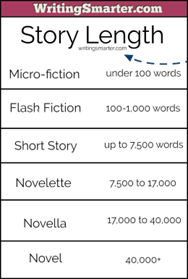
If you submit to magazines (online or paper) and/or writing contests, they’ll likely let you know how many words they are looking for when it comes to short stories, novels, chapters, or other categories. If you are submitting to a particular publishing house or agent, they too will have their own specifications.
As for indie authors, we float somewhere along society’s general standards and our own desires. All my suspense/thriller novels run right around 50,000 words even though industry standards “claim” they should run upwards of 80,000. But I like a 50,000-word length and I can tell my story in about 220 pages. I don’t need it to be any longer. And if my manuscript happens to come out at 39,999, I’d still call my book a novel. Bucking industry standards? Eh, sure…if I was writing for a traditional publishing house. But I don’t. However, I also understand that terminology does have its place. For example, I wouldn’t claim to call one of my 2,500-word short stories a novel.
Q: “How long does a book have to be?”
A: As long as the story requires – no more, no less. One hundred or one-hundred thousand words or pages – it all depends on YOU, the author.
Q: “Can a book be too long?”
A: My personal opinion? Yes. But the better answer is, as long as it holds a reader’s attention, length doesn’t necessarily matter. I find “filler” boring. I don’t need ten pages of description and flowery prose. Others love that. It all depends on the audience.
Regardless of length, all stories (flash, short, or novel) need interesting characters, solid plot lines, and believable dialogue (if the story has dialogue). It’s up to you, the writer, to determine how many words can get you there, and in turn, get the reader to the last page. I would advise writers not to add fluff and filler just to fill pages or hit word requirements. Make every sentence count. Create intriguing characters that jump off the page. Pull the reader in and then take a sharp left turn that they never saw coming. Most of all, choose your words carefully, regardless of how many you decide to use.
July 2023
Payments & Money – Be Prepared
By Sue Rovens
When I started selling my books in 2012 (or should I say, book…as I had only one at the time), I never really thought much about the sales transactions themselves. I think I might have brought a little cash with me, but I was still ill-prepared when it came to dealing with making change, taking credit cards, or handling anything larger than a $20 bill.
Now, after being “in the vendor business” for eleven years, I’ve learned how important it is to meet the customer where they’re at money-wise, if possible. I can’t count how many times I’ve witnessed other vendors lose a sale because they didn’t/couldn’t take a credit card or break a large bill.
If you sell your books at events, it’s wise to have enough cash to cover a $100 bill and then some. While I won’t disclose the exact amount of money I have on hand with me, I’m able to make change for my $5 Toad Bag if someone hands me a C-note (hundred dollar bill). I try to keep the following denominations in my bag: singles, fives, tens, and twenties. Try not to be caught with $80 of singles and have to count back seventy dollars after a ten dollar purchase from a customer.
I also signed up for the Square. As of this writing, a simple Square card reader should set you back between $49 – $59. There are several styles to choose from, but I’ve found that the regular Square works for me and my needs. (squareup.com) Nevertheless, the specific device/company is not the important issue here – the ability to take credit cards is.
The Best Credit Card Processing Companies Of 2023 (Forbes.com)
- Square: Best Overall for Small Businesses
- Payment Depot: Lowest Card Processing Rates
- Stripe: Best for Online and In-App Payments
- Helcim: Best for Fast-Growing Businesses
- Stax (formerly Fattmerchant): Best for High-Volume Sellers
- National Processing: Best Low-Volume Rates
- Merchant One: Best Tiered Processing Fees
- Clover: Best for Specialty POS Needs
- PayPal: Best for PayPal and Venmo
- QuickBooks Payments: Best for QuickBooks Users
The third payment method I take is a personal check. I know this can be a little dicey, but the few that I have taken over the years haven’t come back to bite me. If I were vending in a large city or unknown area, I might hesitate. However, (as of this writing) I’ve been fortunate and have never run into a bounced check or a non-existent account. Most folks don’t normally pay by this method anyway, so this is something that you’ll have to decide on a case-by-case basis for yourself.
I would say, on average, half of my sales are made through the Square. While the company makes a very small percentage of revenue from those sales, I believe it’s worth it and am happy to provide that option for my customers/readers.
If you are new and/or only have one book to sell, give the customer a chance to pay their way. Make it easy for them. Don’t give them any excuse to pass your book(s) by. Society is heading toward a cashless future. Be ready, vendors!
https://www.weforum.org/agenda/2022/10/americans-cashless-economy-research/
June 2023
Topic: Pantster, Plantster, or Plotter?
By Sue Rovens
No, I’m not talking about gardening or shopping for trousers. This month, I’m taking a brief look at three basic writing/planning styles used by authors. There are, of course, a host of other combinations and manners of sequencing, but I’ll only be discussing these three here.
You might have been asked which camp YOU fall into when writing your novel (or other work). If you know, you know, but some folks may be new to this lingo. Let’s break it down for those who might not be as familiar.
Pantster – … someone who, “flies by the seat of their pants,” meaning they don’t plan out anything in their story, or plan very little. Freedom is an important value for pantsers. They don’t need or want a detailed outline. In fact, their writing style—for a first draft or senior book—is partly about discovering the story as they write it. (thewritepractice.com)
Plotter – … is someone who plans their novel in advance. This can include creating detailed outlines to make sure they have believable characters and know their setting and story arc inside and out. For these types of writers, outlining beforehand is incredibly important; they will struggle to start writing without a detailed outline of each chapter and character, and possibly even every scene. (openbookeditor.com)
Plantster – …plantsers are a combination of plotters and pantsers. The reality is that most writers are plantsers who lean more heavily towards either a plotter or a pantser. Perhaps you create a loose synopsis before you start writing, or maybe you like to fully flesh out your characters and then see where the story takes you. Or maybe you outline your story and characters beforehand but make frequent changes to both during the writing process. These are all signs of a plantser! (openbookeditor.com)
As for me and my style, I lean heavily toward the Pantster category. For example, when I wrote Rage (my fourth novel), I knew I wanted to write a story about a guy who was so despondent and depressed that he could barely function. I didn’t have a particular reason for doing so – it was simply a characteristic that I wanted to explore. That’s it. That was the only thing in my head when I started typing the first draft on November 1, 2019 (during NanoWriMo – National Novel Writing Month). What evolved from that point on, happened as I was typing.
When I wrote Sanctum (my latest novel which should be available by the time this is posted), I wanted to write something akin to a haunted house story but didn’t want to go the “usual route”. I considered alternative angles and tried to stay away from overdone tropes. In this case, I imagine I was firmly in between a Plotter and a Pantster (a Plantster!). I had a lead character in mind and knew the overall arching theme. I also wanted to feature an LGBTQ+ couple because I try my best to be an ally.
Whichever category you choose to use, you’ll find pros and cons with each. Being a Pantster means (at least in my case), that you really have to be ALL IN when you are writing. No distractions or else you might lose your train of thought. As the story pours out onto the page while you are typing, it could be difficult to split your attention elsewhere.
You also may find that you’ve written your plot and/or your characters into a corner. When you are typing “on the fly”, all manner of problems can crop up. I’ve had that happen. I just make a note and resolve it in draft #2 or #3. Here’s a modified list from OpenBookEditor.com which might prove helpful:
Pros:
- Flexibility with the story.
- Pantsers get to experience the story as they go—almost like a reader. They can surprise themselves with story ideas and character arcs. This is not only exciting but also gives the author a good sense of how their readers will react to the book.
Cons:
- Because there is little plotting, pansters may struggle with effective exposition and encounter more plot holes.
- As such, the finished draft may need more rounds of editing. This can be especially true when it comes to developmental edits—the large-scale edits that make sure a plot moves smoothly and makes sense from start to finish.
- Because there is no predetermined story direction, pantsers are more likely to get stuck or experience writer’s block.
Plotters have their own issues. I’ve never been much of a plotter, even though I love a list and I’m usually pretty organized. When it comes to writing (a first draft), though, I like to keep it rather loose. If I structure it too much, it feels like work and causes too much added stress. Here is a (modified) list of things to consider if you’re going to try your hand at being a plotter: (OpenBookEditor.com)
Pros:
- Because a plotter will plan out their novel first, it’s easier to get words down once they (eventually) start writing.
- Plotters are less likely to suffer from the dreaded writer’s block because they know where to go next in a given scene.
- The narrative plot tends to flow more smoothly from the first draft. So, regardless of whether they’re editing fiction or non-fiction, such writers will have fewer large-scale, developmental edits to make.
Cons:
- Because they spend so much time outlining, plotters can struggle to be flexible and allow changes to happen as they write.
- Plotters can take longer to complete a manuscript because a larger portion of time is dedicated to planning out every detail—many of which won’t make it into the book—before they start writing.
- If the final product doesn’t quite match up to the outline, plotters may struggle to know when to stop editing their book. These types of writers will often keep editing as they try to achieve the pre-set idea of their plot.
You can probably gather that there is no “right way”. Writers will utilize whichever style works best for them. It could be one of these three, a combination like previously discussed, or something completely different.
Let us know which one YOU use!
May 2023
Business Cards – Worth it or Obsolete?
By Sue Rovens
During an event last year where I was a vendor, I set aside a bit of time to walk around and stop by a few other tables. Normally, I pick up people’s business cards so I can contact them to see if they might be interested in doing an interview on my blog. While I was able to collect a decent amount, there were a few vendors who told me that they didn’t hand out cards anymore. When I asked how someone could get their information, they said “QR codes,” and directed me to a sign that featured a square of squiggles.
Now, I might be old school as I happily claim making the Boomer cut-off (proudly born in ’64!), but I didn’t think I was that out of touch. Were physical cards now seen as an antiquated way of doing business or was my encounter simply a “one-off” with someone who loves technology more than I do.
According to The Marketplace (https://www.marketplace.org/2022/09/14/the-traditional-business-card-is-getting-a-tech-makeover/), 88% of business cards are thrown away within a week. This stat alone is kind of horrifying, considering the cost, time, and effort it takes to create, purchase, and keep them on hand. While some people have a QR code on the business card itself, killing two birds with one stone, it’s still worth considering if going the paper route is financially worth it in the long run.
Having a card at the ready is a great way to connect with a potential customer. I used to have business cards on my event tables and gladly handed them out to people who would ask for them. However, I learned over time that giving away these costly items didn’t bring any more eyeballs to my blog or increase my sales. So, I created bookmarks and put my blog address on each one. That way, the person might use the bookmark and/or visit my blog (where all my information is, including links on where to purchase my books).
I have a small bulletin board in my house with all kinds of business cards: the vet, doctors, plumber/electrician, the company who put in our flooring, the tax lady, etc. Do you know what cards that I don’t have posted? Those of authors and artists I’ve met. People tend to reserve that special “real estate” on a bulletin board or fridge for those services and people that are crucial to their family’s needs. I can’t imagine that my author business card is up on anyone’s wall, which is fine. But it’s another reason I’ve chosen to go the bookmark direction. It’s something that can be utilized and not just take up space.
Using QR codes is an environmentally sound move…but think about folks who aren’t so technologically minded. While most people have cell phones attached to their bodies these days, it’s not a hard and fast rule for everyone. Plus, there are those who just prefer a physical item. (think vinyl as opposed to streaming/downloading). There’s nothing wrong with having both to accommodate the widest audience.
Whichever way you decide to go, keep the following in mind:
- Check your spelling.
- Make sure the technology works (if you go with a QR code)
- Always have updated information on your site and/or cards
- Include at least two ways to contact you (not everyone is on FB/Instagram/TikTok). Email is still vital.
- Include who you are. After an event, it might be hard to remember who you were if someone collected a bunch of cards from different tables. Are you an author, artist, musician, painter, etc?
Once again, there is no wrong answer. You need to discover what works best for you and your goals.
I do have business cards, but these days I’m very selective as to who and when I hand them out. At events, I let my bookmarks do the heavy lifting.
April 2023
A Rose by Any Other Name: Choosing a Title
By Sue Rovens
Choosing a title for your book can be almost as daunting as writing the manuscript itself. While a great title can capture a reader’s attention and entice them to follow through by making a purchase, a bad or awkward title can elicit the opposite response. If it’s too long, too generic, or doesn’t fit your genre, your book’s title can work against you and any potential sales.
As with most topics I cover in All Business, the internet is home to a wide array of websites bursting with ideas. I’ve credited three such links which can be found at the bottom of this article which have proven to be quite helpful.
~~~~
Listed below are some tips that I found during my research. I’m also including how I come up with my own titles (and the reasons why).
Things to keep in mind when choosing a title:
- Keep it short (or on the shorter side) – It’s easier to remember a few words rather than a lengthy title (although there are exceptions)
- Make it unique – Make YOUR book stand out from the crowd.
- Come up with a few titles before settling on one – Brainstorming is a good way to come up with good ideas. You might even end up combining two.
- Have the title match the story and genre – No reader wants to be fooled.
- Edit (yes, even the title may need editing).
- Don’t settle. If it doesn’t feel right, change it until it does. You may start out with one title, write the manuscript, and ultimately decide that your original thought doesn’t fit.
- Cram every plot/character into the title. Sometimes less is more.
- Use “in jokes” or “be too clever” (You might know your personal jokes, but some of your readers won’t get it).
- Lean too heavy on trends (They come and go too quickly, and you don’t want to end up ‘dating your work’. What’s cool in 2023 might not be cool or even understood in 2040).
Apart from my two collections of short stories (In a Corner Darkly, Volumes 1 & 2), my novel titles are either one or two words long (Badfish, Track 9, Buried, Rage, and the newest coming out later this year, Sanctum). I chose to go the shortest route I could, hoping that readers would remember the titles easily. I wanted to represent the gist of the story, the genre, and the tone with one (or two) words – to be as succinct and eye-catching as possible.
I also let the title come to me on its own. It happened during the first draft of Badfish and Track 9, and it happened during the latter drafts with the other three. When the name pops into my head, I know, instinctively, if it’s right or not. I never force it.
Additionally, I’m very aware that I’m up against a tremendous amount of competition when it comes to attracting readers.
According to the latest Bowker data (Publishers Weekly, February 20, 2023), 2.3 million books were self-published in the US in 2021, which was the third year in a row that more than 2 million books were self-published.
With these kinds of numbers, it’s not hard to see that having one’s book available on Amazon is barely enough to make an impact. My books are a drop in the proverbial bucket when it comes to readers looking for their next suspense novel. If my single word title (and cover art) can capture their attention for a few seconds, it could be enough to persuade them to click on it (or pick it up at an event). Everything matters – even a single word title.
I’ve had a couple folks point out that a few of my books have the same titles of other books (and movies). It’s true. But it’s also accurate to say that my work will likely never be mistaken for Stephen King’s or Bob Woodard’s (same titled book, Rage). Most of my selling comes from the events I attend and the interactions I’m fortunate enough to make. I can’t imagine someone mixing up my short suspense novel for a best seller any day. 😊
There is no definitive right or wrong when it comes to choosing a title for your book. Rather, it’s about deciding on the BEST word or words to represent you and your work to your audience. Once again, these guidelines and suggestions are merely just that – tips and ideas for you to consider before hitting publish.
How do you come up with your titles?
https://nybookeditors.com/2017/02/coming-perfect-title-novel/
https://scribemedia.com/how-to-title-book/
https://ideas.bkconnection.com/10-awful-truths-about-publishing
March 2023
Recognizing Change
by Sue Rovens
“Ch-Ch-Ch-Changes”
–David Bowie
Whether you have been writing for one year or fifty, there might come a time when you find yourself questioning your desire to continue down the same path you’ve been traveling on or make a sharp, left turn and diverge in the great unknown. Choosing a different genre, writing non-fiction as opposed to fiction, or simply stopping altogether are some manifestations of such evolutions.
Change can be scary, whether it’s forced upon you (getting fired from a long-term job, a relationship suddenly turning sour, or having to move), or whether it’s something of your own choosing. Continuing down a familiar path, even if it’s not working for you, can be comforting. It’s the “devil you know” as opposed to facing a metamorphosis full of questions and uncertainty.
During the past year, I’ve considered the following:
- Stop writing new content. Sell everything I have and just be done with it.
- Write non-fiction instead of my usual fiction (suspense)
- Drop my other hobbies and interests and focus everything I have into writing more stories.
- Continue doing what I’m doing – at least for the immediate future.
While none of these are wrong or bad (save for #4 which isn’t really much of a change), each one carries its own cache of issues. The worst and most draining of these would be having to defend the decision to do something different.
“Know When to Fold ‘Em”
– Kenny Rogers
I’ve been a drummer in some form or another since 1981. I began in my high school band, then continued in college, and eventually found my way into playing in church bands throughout a portion of my adult life. Family members and friends knew me as a drummer (not famous or great, but a percussionist nonetheless).
While I haven’t actively played for several years, about eighteen months ago I took up French Horn. Why? Because I had a dream about playing one over twenty years ago and wanted to make it a reality. I had no lofty ideals about becoming a professional hornist, nor had I developed a hatred for drums and drumming. I just wanted a change. I had a desire to try something new.
However, instead of shared interest and excitement, I found myself having to go on the defensive. Not only did I feel the need to deflect the why and why now questions, but I felt pushed to convince those who knew me that no, I didn’t despise the drums. I still held quite an affinity for them. I’d welcome the chance to play if an opportunity presented itself. But the need to explore a different path would still loom large and I would be doing myself a disservice if I didn’t make the attempt.
Why was the idea of change so heavily questioned and seen as dubious and suspect?
I could certainly understand the concern and worry if I had alluded to a life-altering decision such as a divorce, moving to another state, or having been diagnosed with a sudden illness. But this had to do with learning a new instrument.
Is it any wonder why considering a change in writing habits can cause trepidation? Sometimes, the decision to commit to a new path is nerve-wracking enough. The added weight of having to defend and explain the change can tip the scales in the wrong direction and push the person to give up altogether before they’ve even started.
Someone is bound to feel uncomfortable and awkward, until the “change” becomes routine again, but it shouldn’t be the writer (or musician or artist).
I’ve found myself reading more non-fiction as of late. While I still enjoy a great suspense/horror read, I find that I’m more selective now. I’m in a process of finding a balance and discovering new territory. I’ve been enjoying reading for educational purposes as opposed to only reading for entertainment. I don’t despise good fiction. I’m not turning my back on the genre that I love. What I am doing is changing. Expanding. Learning. Diversifying.
It’s the same with writing. I’m currently working on my fifth novel, Sanctum. I plan to come out with another book of short stories (horror/suspense) sometime in 2025. But after that? I’m considering writing non-fiction. It may happen…or it may not. But either way, there’ll be nothing wrong with my decision.
As a writer, you have to do what is right and best for you, regardless of timing, naysayers, and critics.
February 2023
Choosing Events as Vendors
By Sue Rovens
I don’t know about you, but I do my best sales when I’m face to face with a potential reader. Through personal interaction, questions and answers, and an honest back and forth engagement, events provide a fertile ground for communication, reader/writer acknowledgment, and sometimes sales.
For me, it’s not if I should vend, but rather where, when, and which are best. How do any of us know which events are worth the time, table fee, travel costs, and effort?
While I can’t make those individual choices for you, I can share some of the things I’ve learned along the way. As of this writing, I’ve been a vendor 43 times. Charlie (my husband) and I have loaded the car, schlepped the two-wheeler, hoisted signs, packed up boxes, lugged the typewriter (for my display) and cartons of swag and decorations, and set up tables since 2013. After ten years of experience (though I imagine some of you have done this many more times), here’s what I know:
- Just because you’re selling books, you don’t have to stick to “book only events”. Early on, I thought this was what authors were supposed to do. While there is nothing wrong with attending Book/Author Fairs, there are other opportunities worth experiencing. Overall, I tend to sell better at places that aren’t solely book focused. I’ve noticed that attendees can become overwhelmed, and ultimately become very selective about the few books they actually purchase. Instead, I’ve gone “outside the box” and sold my wares at Steampunk shows, Horror Conventions, Craft shows, and Flea Markets. Sometimes, when a book vendor is the exception rather than the rule, their booth stands out more.
- Table Fees. The dreaded things can make or break being a vendor. While some events waive their table fee completely, ask yourself the following – do they publicize the event? Will you have attendees? If the venue doesn’t promote at all (or just barely), you might end up sitting with the other vendors killing time and making nothing (but a contact or two) Free doesn’t always mean better. On the other side are the events who ask exorbitant fees. It’s important to consider your other costs (travel, food, gas, etc.), and see if the bottom line is worth it. Sometimes, I’ll go ahead and take a flyer and pay a little more than what I want to because the venue and event appear to generate a huge following. In most of those cases, I’ve been lucky. But, like anyone else, I’ve been caught paying a table fee and NOT earning it back. It happens. Keep a record to see which events worked out for you, which did not, and why.
- Speaking of publicity, that’s a key factor which I’ve been learning about as of late. There’s nothing wrong with asking the person in charge about past attendance numbers and/or how many they expect. Covid years aside, if it’s an established event/fair, the people running the show should know their numbers. If it’s a brand-new event, it’ll be a guess on everyone’s end. I’ve been to a few premiere shows and have done well, but unless they double down on advertising and marketing, it could end up being a long, lonely day for all involved. Incidentally, if they retort with phrases like “well, it’s in a mall” or “it’s impossible to tell how many will show up” or something just as evasive, I’d hesitate to commit. It’s important that the people in charge are on the ball and take the event seriously, especially when vendors are paying hard-earned money for a spot at their show.
- Where do I find these places? First, networking – the obvious choice. When at a fair/show, I’ll ask other vendors (and no, they don’t necessarily have to be authors) where else they go. I’ve met some wonderful folks who are more than happy to share what they know (both good AND bad). Another place is the internet (of course). Google Illinois Book fairs/festivals, author fairs, author book signings, as well as searching public library pages for author events has been helpful. Lately, I’ve searched Central Illinois Craft Show/Vendor Updates (and variations on this to target different areas throughout the state). Obviously, different states will have their own pages. I’ve also searched for local happenings (Cogs and Corsets – the Steampunk Event in Bloomington), Duncan Manor (a local establishment which hosts musicians/artists from time to time), local restaurants (Destihl Brewery which puts on artist/Maker’s Market-type shows throughout the year), and the Holiday Expo (a local hotel which offers the public an opportunity to shop many different vendors a couple times a year).
- The best way to know is to try different venues and see what is the best fit for YOU and YOUR work.
While this list certainly isn’t exhaustive, I hope it provides a starting point (or reminders) of things to consider. I’ll most likely do Part Two sometime in the future. In the meantime, good luck in 2023, and feel free to share your own vendor experiences with us.
January 2023
First Drafts
Written by Sue Rovens
The first draft of nearly any manuscript can cause its author stress-inducing nightmares. The all-powerful empty page, looming large like a formidable opponent, has haunted well-known authors and complete novices alike.
It’s unfortunate for creative writers to get tangled up with worry and trepidation so early in the process. I’ve been told (and have read) how some people fret so much over the first sentence, let alone the first paragraph, that they ultimately give up out of fear and perfectionism. Seeking excellence and clarity right out of the gate is so rare, I’ll go out on a limb and say it just doesn’t happen. That’s that point of editing rounds and subsequent drafts.
First drafts, also known as rough drafts, are supposed to be exactly that – rough. It’s an opportunity to get the basics down so you can polish it later. It the proverbial “drawing board”, the brainstorming session, the initial conceptualization for plots and character development that will eventually become a real manuscript. A story arc might change five times before you’re happy. An important character might appear in chapter three, but by chapter fourteen, they’re all but forgotten and you realize they were never truly needed.
There are hundreds, if not thousands of websites that discuss first drafts – how to do them, how NOT to do them, etc. But ultimately, it’s going to come down to you, your style, and your comfort level. If you feel the need to have a list, then by all means, make one. If you rather “pants it” (fly by the seat of your pant, AKA ‘pantster’), then go for it. There really isn’t a wrong way…except being so afraid to start that you never write your story.
Here is what works for me:
- I take advantage of NanoWriMo (the National Novel writing month that happens every November). It’s a great free program that I’ve used to write all five of my first drafts down on paper. https://nanowrimo.org/
- I normally start with an idea, a character, or a scene. For example, when I started writing the first draft of Buried (my third novel, about a hoarder who lives next to a funeral home), my first inkling of an idea came from watching the TV show, Hoarders. A lady had dug through a funeral home’s garbage in order to find (and use) body pads for bedding inside her trailer. After I saw that, I knew I had the basis for a story (and a leading character). Where would it end up? It didn’t matter at that point. I had the first few kernels of a concept and let it grow from there.
- I don’t worry about spelling, remembering specific names (including stores, last names, addresses, etc.), ages, or even proper usage of syntax during the first draft. All of those are fixed in later drafts.
- I’m not beholden to anything that comes out in the first draft. When I wrote Track 9’s original draft during Nano 2017, I struggled to come up with ANYTHING to fill the page during the first half, and then, after getting sick during the second half of November, I wrote the rest in a antibiotic-addled sinus-infection dream. It was HORRIBLE (lol). I ended up throwing away 90% of the original manuscript. And it was all for the best. Track 9 ended up getting a starred review in Publisher’s Weekly (2018). So, first drafts can easily go by the wayside. Don’t stress about it. What you’ll ultimately end up with will be so much better.
- Once I finish the first draft (on November 30, following Nano’s “rules” – although, here again, you don’t have to. It’s totally up to you. I just like being done in 30 days!), I set it aside for a good three months before I look at or think of it again. This way, when I come back for Draft #2, I’m in a different state of mind. The concepts and characters are there, so I’m not starting with nothing, but I’ve got something to work with, even if I delete some or most of it.
Writing a story is a personal adventure. No two people (probably) do it the exact same way. Find out what works (and doesn’t work) for you, whether it’s a list, an outline, a character analysis, random ideas scribbled on a napkin, or just sitting down in front of the keyboard and going off the dome with nary a guideline in sight. That’s what a first draft is all about –getting through it so you have something to work with later.
December 2022
Trigger Warnings
Written by Sue Rovens
“The term trigger warning originated in the late 1990s on feminist Internet message boards, where it referred to site-sponsored cautions to readers regarding the presence of graphic depictions of rape in certain posts. Reading such material, it was argued, could trigger panic attacks and other symptoms of post-traumatic stress disorder (PTSD) in victims of sexual violence. Soon the term and the practice were applied to other discussions in the interest of protecting the sufferers and victims of a wide range of disorders, conditions, and traumas, including eating disorders, self-mutilation, suicidal tendencies, and domestic abuse.”
(https://www.britannica.com/story/trigger-warnings-on-campus)
Trigger warnings have been and continue to be a hot topic and it doesn’t appear to be slowing down. They now appear at the start of select movies, several television programs, and even certain podcasts. While still in its infancy, only thirty-some years in, the concept of providing trigger warnings may eventually be so commonplace that the debate of whether or not to include them might simply become futile. Trigger warnings could be the new standard, and not the exception to the rule.
But should they be? Is that the best direction for the future of entertainment? In other words, all the above-mentioned traumas (stated in the first paragraph) have existed for years. Why are cautionary warnings needed now as opposed to the 1920s or 1930s? Or during the Vietnam years? Or during The Great Depression? Weren’t things just as bad (or worse)? Yet, the need to warn readers or movie-goers wasn’t necessary then. Should trigger warnings have existed earlier or were people simply “tougher” back in the day?
Readers and writers alike tend to have an opinion on the matter. While there are some who might remain indifferent, trigger warnings have fans as well as critics.
Whichever side you prefer, there is much to consider. Many in our current society are becoming aware of behaviors, labels, and viewpoints which were once deemed “acceptable” but were in actuality, stereotypical, racist, misogynistic, or otherwise harmful. In these cases, providing a trigger warning about upsetting or harrowing subject matter can be seen as a good thing. It shows concern, consideration, and sensitivity toward others.
Individuals who don’t wish to be startled or relive a traumatic experience may be cautioned against reading a book (or seeing a movie) by the appearance of a well-placed trigger warning. It can help provide a “safe passage” for those looking to indulge in entertainment, but who don’t want to deal with distressing issues.
However, it has been said that trigger warnings are merely a contemporary means to ‘bubble-wrap’ the world. Life is hard. Bad things happen. Authors shouldn’t be held responsible or accountable for creating a “safe space” for readers, unless perhaps, they write for children. Some people enjoy indulging in the seedier side of things. True crime is wildly popular these days in all manner of entertainment outlets. For those who gravitate to such material, trigger warnings only serve to placate and pacify, almost becoming a spoiler alert in some cases.
My personal feelings about trigger warnings lean toward the latter. Granted, I’m an indie author. If I had an agent/publishing house that insisted I use them, I wouldn’t balk. I would go along to get along. But, since I do have the ability to choose whether to include trigger warnings (or not), I’ll share my reasons as to why I don’t plan on using them.
Reason One – I write suspense (with flakes of horror). When a potential reader picks up my books, they will instantly know the genre, the general theme, and, if they read the back blurb, the main plots and subject matter. The covers present obvious themes. No one should be surprised by finding something unscrupulous, disturbing, weird, chilling, or unseemly in my work. These are not romance novels. The cover, blurb, and synopsis on Amazon should be ample ‘warning’ to potential readers. The addition of trigger warnings, I feel, is not needed.
Reason Two – News programs, internet pages, and social media are practically a free-for-all these days. The standards and practices of an earlier time no longer exist. Some people can be mean, rude, or just plain hurtful, and they sure don’t come with a trigger warning (hmmm, maybe they should). Life in general doesn’t give most of us a “heads up”. There are ugly, horrific things in this world. If someone is expecting to be notified before encountering something disturbing or scary, they’re in for some harsh lessons.
A frightening or disturbing book can be set down, given away, or remain unfinished. A movie can be shut off. Real life can’t be as easily discarded as forms of entertainment can.
Whether to include trigger warnings or not remains a personal or professional decision, it will likely persist as a divisive topic for the foreseeable future. Which side do YOU come down on, and more importantly, why? Have you changed your mind? Are trigger warnings a non-issue for you? Please share your thoughts on the All Business Update message!
November 2022
Book Covers: Images and Fonts
Written by Sue Rovens
The cover of your book should convey the right amount of information – not too much and not too little. When a potential reader sees your book for the first time, they tend to dwell on it for as long as ten seconds before deciding to investigate further or look elsewhere. Imagine a person scrolling through hundreds (or thousands) of choices on Amazon (or any other book site). Simply writing the darn thing isn’t enough. You should “start selling” by creating an intriguing cover.
Those first moments are crucial and can make or break a sale. If the person finds the graphic, font, or back blurb to be off-putting for any reason, they’ll quickly move on to the next book, whether in person or on screen. Of course, no one can make a cover that will delight every reader. But if we follow (or at least consider) some long-standing rules and tips, our books have a better chance of ending up in a new reader’s hands.
While an author with an established following will sell their books regardless of what’s on the front, it’s important for the majority of writers (especially indies) to present our work in the best light possible. You want your book to stand out from the crowd, instigating a connection to a new reader. A good cover can prompt someone to skim through the pages, read the back blurb, and invest their hard-earned cash in someone they’ve never read before.
Constructing the cover can happen in all manner of ways these days. You can hire it out to an artist, do it yourself, or combine both factors. I pay a wonderful illustrator who collaborates with me on mood, tone, ideas, and cover vision. She creates a few mock-ups, sends them my way, and from there, I can let her know what works and what does not. It’s a process that I’ve found helpful and as far as I’m concerned, she’s nailed my vision every time. (She’s done the artwork for Rage and Buried and created my Plump Toad Press logo. I heartily recommend her – Tami Boyce)
Obviously, you want the graphic and/or illustrations to look professional (if you choose to use them). However, and I can’t state this enough, it’s important to visualize how it will look as a thumbnail on Amazon. It’s going to be small. Really small. Yet, it needs to be clear and convey your book’s message/genre/target audience. (I write suspense/thriller):
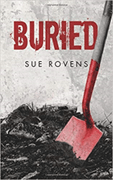
Let’s look at an example:

Okay…what the heck is going on here? Besides for appearing cluttered and messy, the genre isn’t clear at all, nor is the target audience. While all of these elements might appear somewhere in the book, a potential reader would most likely see this and be confused. Is this a kid’s book? A mystery? What’s up with the enormous cookie that’s larger than the cat? Is someone being poisoned? And the feet? Is the steam coming from the cup or the foot and do we want to know?
We don’t need everything laid out here. Pick one or two elements and go with that. Also, look at the title and author’s name. They’re jammed up at the top and gives the cover a childish appearance. Your title AND your name are important. Make them stand out – clear and precise.
***
The style, size, color, placement, and font choice are also important. As cute as a curly font might be, it wouldn’t be a good move to use it if you are writing a serious thriller. And if you’re writing a kid’s book or YA, you might want to steer away from this font, or this one.
Let’s look at another example:

If you use a particular font for the title, stick with it for most other wording on the cover and make sure it fits the genre. This example is trying to be “clever” but comes across as kind of annoying, messy, and unprofessional (although I’m sure that some people will like this). The author or designer could have chosen one word to highlight (like creativity) by using a varied font but kept the rest of the title uniform. By doing that, it would make a thumbnail on Amazon easier to read. Notice the word “creativity”. Doesn’t it sort of look like weatiwity? And the word “the” gets a bit lost, especially if you’re looking quickly. The colors as the background are fine, but with the jumble and randomness of the title, it’s too much. The background is busy enough.
One final example:

See how the title and author’s name disappear? The main image is also impeded. Is this a book about gardening? A romance? It’s hard to tell because it’s too basic. Plus, it’s not eye-catching. Regardless of how well the book is written, I might never know because nothing about the cover pulls me in. Sure, the back blurb could come to the rescue, but if it doesn’t grab your attention to begin with, it’s likely to be passed over. Don’t force the reader to work too hard. Make the cover easy to understand and capture a reader’s attention. Remember –you only have seconds to make an impression.
While every cover can be criticized and judged, there are guidelines and tips (many more than just these!) that will help make the process of cover creation easier, better, and will provide you a leg up.
How do YOU create your covers? Good or bad experiences? Let us know!
(https://callingcardbooks.com/10-book-cover-mistakes-that-self-published-authors-make/)
===========================================
October 2022
Editing: A Brief Look
Written by Sue Rovens
Stating the obvious here, but volumes have already been written on the topic of editing. They’ve been done by more established and more qualified people than me. Add in the blogs, professional classes, week-long seminars, and multitudes of speaker series, and you might wonder why I’d even offer my two cents on the matter.
I’ve come to find that while editing generally has some common themes and processes, each writer approaches their own manuscript a little differently when it comes to personal corrections. Therefore, I’m sharing mine. I’d love for others to share theirs as well.
Editing a manuscript is too large a concept to be taken in all at once. We understand that the process of editing can take just as long (or longer) than writing the actual book. The topic itself deserves a great deal of attention and discussion. And while these articles aren’t meant to be a stand-in for professional teaching or scholarly content, they might serve as reminders, introductions, or helpful supplements.
A general breakdown of editing:

Please keep in mind that this graphic is only one of MANY that can be found on the internet. What I’m sharing here is how I go about proofreading, which is the bottom section of the graphic above.
Normally, I edit the manuscripts of my novels around eight or nine times. I also have other people editing/Beta Reading in between my own developmental, structural, and copyediting passes.
While I am always on the lookout for misspellings, missed punctuation, typos, and grammatical errors, I set aside one round of edits to address ONLY these specific issues. I blow up the font to around 180 (or more) and read everything out loud (to myself…and the cats if they happen to be in the room).
I’ve caught more errors this way than any other. It’s amazing how many mistakes slip by even after reading it countless times. I normally consider my manuscript “done around edit number seven, but I will read through and scan another time or two for any incidentals that might have slipped by the other times. After I send it to my layout person, I still have managed to catch errors. She allows me three rounds of corrections (without charging more), and I normally utilize two of those rounds.
We’ve all read books by professional authors who have the backing of a major publishing house and editing team – and still find the occasional mistake or typo. It’s extremely difficult to catch everything. However, it’s critical to do everything humanly possible to rid your work of such blunders, even if it means eyeballing every single word in a larger-than-life font.
There are times when the wrong word will not be caught by a computer program. For example, the word “too” and the word “two” will not necessarily be highlighted as problematic. Both words are fine in and of themselves, but which one do you need? The number or the adverb?
Between reading out loud, blowing up the font, and staying extra vigilant on terminology and word choice, I’ve found that I have far less errors in the manuscript when I finally send it off to my layout person. When it’s ready to upload to Amazon, I feel 99.9% confident that I’ve done all I can possibly do to produce a work that is error-free.
How do YOU proofread/edit your own work before publishing it?
=================================================
September 2022: Swag
Written by Sue Rovens
Swag.
The word itself has a variety of connotations, but in our case, I’ll be referencing what we all know and love, which is, according to the Merriam-Webster website, “The freebie swag, sometimes also spelled schwag, dates back to the 1960s and was used to describe promotional items. According to our files, early swag was everything from promotional records sent to radio stations to free slippers for airline passengers. In short order, this particular meaning of swag broadened and soon referred to anything given to an attendee of an event (such as a conference) as a promotional stunt.”
Why would authors care about such a thing? Aren’t we supposed to be more concerned about selling our books rather than worrying about excess trinkets that might end up in the garbage anyway? I believe the answer is twofold – yes and no.
No, we shouldn’t lose sleep over pencils and pads of paper. But, authors, especially indie authors who don’t have a large agency at their back, need to be in the business of getting and keeping people’s attention. Sometimes that means providing “an extension” to our brand/books. Once a reader turns the final page on our hard work, what prolongs our name in the reader’s mind?
If people enjoy what we’ve written, the work itself goes a long way to help establish repeat business. But how many readers take the extra step and leave a review online or tell their friends about it? I’ve seen some numbers, and they’re not promising – 0.5 – 3.0 % of Amazon readers will post a review. That’s not many.
Swag is not just fun to hand out, but it can be seen as a tool. While our books are, of course, priority, the act of selling OR giving away that little extra at the point of purchase can help solidify our “brand”/name, and serve as a reminder of a good experience long after our book has been read and put on a shelf.
In my experience, I’ve found that people enjoy receiving swag. Every time I sell a book (during events), I always include a bookmark. One side features a picture of the cover from the book they’ve purchased, while the other side has my blog address. I believe the addition of my address is important, because this not only provides a further connection to my work, but also gives them an (otherwise unknown) opportunity to discover all the other author interviews I have listed as well. The circle of reader/writer has a chance to grow exponentially.
I used to put my bookmarks (and business cards and pencils) out for anyone to take during events. I know many folks still do that and if it works for them, that’s great. However, I ended up losing money and the ability to connect with readers when I did that. I found that some people would feel “obligated” to take a bookmark/business card because we briefly engaged in conversation. I certainly didn’t want to stop them, but I feel that most of those items ended up in the ‘circular file’ – thrown away.
I also had some folks take handfuls of pencils (which hit financially) because they wanted them for their own projects/school/kids. I’m all for taking freebies from tables, but they were carrying off almost half my stock at one time (and weren’t interested in my books at all).
While it’s true that swag is there for the taking, I now err on the side of practicality and cost effectiveness. Sometimes I’ll put out candy, but I don’t consider that “part of my business model”. It’s only when I go online, order stock, and pay the dreaded shipping cost, that I choose my table placement carefully with said products.
I’ve also found some reliable websites that I’d like to share with you. I can vouch for them that, as of this writing, I’ve never had problems or issues crop up with any of my orders:
Vista Print – https://www.vistaprint.com
Uprinting – https://www.uprinting.com
MOO cards – https://www.moo.com
Much more can be said about the topic of swag, and I’d be happy to share more of my own experiences and thoughts on the matter in another installment. If someone else would like to expound on their side of the swag discussion, let me know. The more information we exchange, the better for us all.
Thanks for reading.
==========================================================
Hello!
The NEW segment of the blog – All Business – is sending out a call for ANY and ALL writers. It doesn’t matter what genre you typically write or if you do this part-time, I am looking for YOU.
All Business will be a monthly segment that will touch on a plethora of topics. The focus will be advice, past experiences, suggestions, tips, and/or a combination of all of the above. It can be serious, humorous, or plainly factual. It’s up to you and your writing style.
What it isn’t – complete and total self-promotion. You can certainly use experiences you’ve had IN the article, but save the promotional outpouring for afterwards.
Which brings me to the next point. Normally, I don’t allow pictures of authors in the Meet & Greet. This is different. You can promote your work WITH a few photos if you do an article. It will be posted at the end of your submission.
So, here’s the plan:
When new articles will be posted: Monthly
Who can contribute: Any writer/author of any genre or professional level
What length: Fairly Open (less than 3,000 words but more than 300, but not a hard and fast rule)
Why: To share information. To encourage other writers. To help those with similar issues or provide new ideas.
Likely Staring Date: September 2022
Pay Scale: None. But authors can promote their work(s) at the end of the article and include photos!
So – I need YOU! Send me an email if you are interested in doing this. Not a lot of time now? Fine! I can schedule you months out. I’m looking for the following topics, but if you have other ideas, let me know. No hard and fast rules, as I said. And since some of these topics are very broad, you can cover whatever angle you wish.
Topics I’d like to see covered:
Table Fees
Marketing / Promotion
Being a Vendor (pros and cons)
Publishing (traditional, hybrid, small press, self-pub)
Swag
Cost of publishing/printing/editing
Scams
Genres
Fiction vs. Non-Fiction
Pitching books to potential customers (how to close a sale)
Writing to fill a word quota
Contracts / Legal matters
Getting books into stores (brick and mortar)
Editing
Beta Readers (pros and cons)
Reviews (so. many. angles.)
Cover Art (hire it out? DIY?)
Blurb Writing
Trigger Warnings
Again – these are ideas. Have something else in mind? Let me know.
Please send me an email if you are interested. srovens@yahoo.com.
Any questions? srovens@yahoo.com
 Sue Rovens
This is a great idea, Sue. I always like to hear viewpoints from other authors and learn something new.
LikeLiked by 1 person
Thanks, Teri. I know a lot of folks do this kind of thing, but I’m hoping to bring some new angles to the table.
LikeLiked by 1 person
This is a fab idea for a new blog feature. I look forward to learning a lot!
LikeLiked by 1 person
Thanks, Priscilla! I know this kind of thing has been “done before” on a number of other blogs. I’m trying to come up with a slightly different angle for the column before I actually start it. 🙂
LikeLiked by 1 person
Hey, I blow up the text (or change the font, or change the color of the font) and read it aloud. You’re right; it helps catch errors that silent reading of a plain font misses.
LikeLiked by 1 person
That’s awesome! It’s been a really helpful way for me to catch errors.
LikeLiked by 1 person